Food rituals, ADHD, and the science of feeling more held
I read a paper last week that I’ve not stopped thinking about since. The article in question is about food and drink rituals, which may sound very anthropological, and I suppose it is. But it also felt immediately relevant to my everyday work of supporting ADHD nervous systems, especially when food has become tangled up with pressure, shame, inconsistency, sensory overwhelm, emotional eating, or the constant expectation to “just be more organised”.
Eating and drinking are never just about nutrients
The reason why I decided to write about this paper and share it here in my newsletter is that its message is 200% aligned with mine. I will never tire of saying how eating and drinking are never only about nutrients. They are also about meaning, memory, rhythm, identity, connection and emotion. I wrote about this in ADHD Body & Mind, and I’m over the moon to know that there are scientists out there doing research on this.
A cup of coffee in the morning is rarely just caffeine. A bowl of soup can be warmth, care, recovery, childhood, winter, a pause. A family meal can be belonging, or tension, or both. A snack before leaving the house can be a tiny act of protection. Even the way we make tea, chop vegetables, plate food, sit down, light a candle, choose a favourite mug, or take the first sip can carry more nervous system information than we realise.
What the paper made me think about
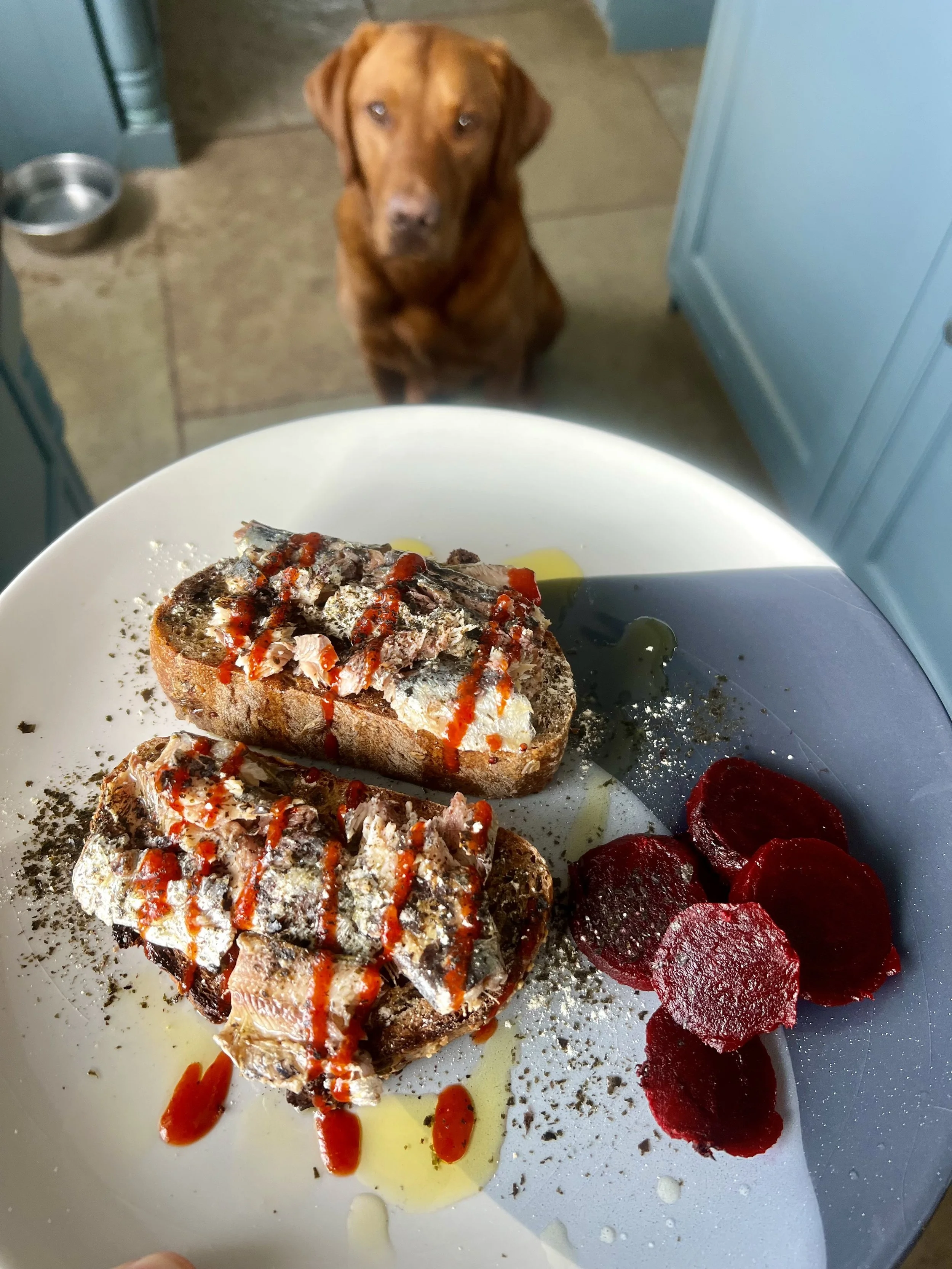
A simple snack at home can still become a small food ritual. Not because it has to be fancy, perfect, or Instagram-ready, but because the way you prepare and present food can change how the body receives it. For me, it’s things like using my favourite plate, adding a drizzle of olive oil and/or a bit of colour on the side. That moment of “this is for me” makes me feel happy, even when it’s just sardines on toast with beetroot and a very hopeful Labrador watching my every move.
Food is never only macros and micronutrients. It is texture, attention, memory, pleasure, safety and meaning. When we take a few extra seconds to make food feel inviting, we give our nervous system a cue that nourishment is happening. And for ADHD nervous systems, that matters. A lot…
.
The neuroscience angle
When we look at this through a neuroscience lens, it starts to make a lot of sense. Why? Well, rituals create predictability. And predictability, when it’s chosen rather than imposed, can reduce cognitive load. For those of us with extra-sensitive ADHD nervous systems, this matters because so much of daily life can feel like an endless series of micro-decisions. What shall I eat? When shall I eat it? Do I have enough energy to cook? Have I left it too late? Is this food “good enough”? Has it got enough protein? Is it low carb enough? Is it ultraprocessed and therefore “bad for me”? What is the alternative? Maybe I should look it up, but I am burned out just thinking about it… Why can I not be consistent like other people seem to be?
That is a lot of noise before we have even opened the fridge. Welcome to my brain!
A small food ritual can soften some of that noise. Not because it’ll “fix your ADHD”, and certainly not because it turns eating into another performance of discipline, but because it gives your body a recognisable sequence. Something familiar that says, “we have done this before and it felt safe then, so I am assuming it will also feel safe now”… So your nervous system can take a moment to exhale and chill from the exhausting, never-ending scanning, trying to figure out what is the safest and least energy-intensive route. No wonder our executive function is buggered!

Science, story and nourishment for neurodivergent life, straight to your inbox.
This might be as simple as making the same breakfast on busy mornings. Keeping a “safe snack” in the same visible place. Having a warm drink before starting work. Using a favourite bowl because it makes the meal feel more inviting. Sitting down for the first three mouthfuls before deciding whether to carry on scrolling. Taking a breath before eating, not in a mindful-eating-perfect-person sort of way, but just enough to let the body arrive.
Whatever you can do is likely to be good. It all counts.
This is where I think the distinction between routine and ritual becomes helpful. A routine can feel like something we have to obey. A ritual feels more like something we participate in. It comes from within and has texture and meaning. It may be repeated, but not robotically. Your body recognises it before your mind has had time to turn it into a task, and that is a good thing.
This is central to my PHOCUS framework, which I discuss in detail in my book, and which I’ll be discussing even further in my upcoming masterclass.
What??
You didn’t know I am running a Masterclass on Wednesday, 15th July where I’ll be discussing all of this stuff in depth, and giving you lots of practical tools to put it into practice?
You can learn more about the Masterclass here, and you can reserve your place below.
Enjoy lifetime access to the complete PHOCUS Masterclass and private members’ area. Your purchase includes the full masterclass recording, presentation slides, the PHOCUS on the Plate Practical Guide, PHOCUS Workbook, and detailed guides to working with your PHOCUS Eating Map and PHOCUS-T Safety Map results.
Food rituals as a gentle doorway
I love rituals because they allow us to ask better questions, and I thrive on that way of thinking. In a world where we’re brainwashed to get instant answers, I believe the best brain training is to actually stop for a moment and develop a bit of critical thinking by asking yourself simple questions like: What would make eating feel easier today? What sensory cue would help me begin? What tiny repeated action would make this meal feel less random and more supportive? What could I prepare when I have capacity that might help me when I do not?
Rituals also help us connect with the social side of food. In fact, I was reading the paper and my imagination was taking me to times and places where eating and drinking rituals were a big part of the enjoyment. Sharing food contributed to forming those memories that I cherish as special, and it wasn’t the protein in the seafood or the polyphenols in the grapes, but the intangible, the magic, the beautiful connection between those present at that meal that strengthened those neural pathways in my brain. Coffee breaks with my work wives and husbands, shared meals with my mum, dad and sister, birthday cakes with my besties, tasty food at a festival after lots of sweaty dancing, and my first nut roast at my long-term veggie friend’s house… All these memories are nourishment themselves, and they’re incredibly regulating because they are intrinsically interwoven with the emotions we felt at that moment, and with the love and appreciation we feel for those people who were with us at the time. This also reminded me that food is not just fuel. It is relationship. It’s one of the many beautiful ways we humans say, “I am here with you”. For us ADHDers, this can be especially important because shame can and does isolate us. We can feel embarrassed about irregular eating, emotional eating, sensory aversions, forgotten meals, impulsive snacking, or relying on the same foods repeatedly. So, when we bring ritual and meaning into the conversation, food becomes less about moral success and more about support.
Drinking tea out of your favourite mug is not trivial if it helps you pause. A simple breakfast is not boring if it helps you start the day with less friction. A repeated snack is not failure if it protects your mood and attention. The blood glucose support is an added bonus, but shouldn’t be the absolute goal… Eating with someone who makes you feel safe may do more for your digestion than the most perfect wellness bowl eaten in a state of self-criticism. After years of struggling with my relationship with food and eating, years of hypervigilance around macro and micronutriennts, this is the direction I keep coming back to in my own work: food as support, not surveillance. Nutrition as a way of building capacity, not another stick to beat ourselves with. Oh, and the science matters, of course. Protein, fibre, polyphenols, omega-3s, fermented foods, micronutrients, gut-brain signalling; all of this matters. But our bodies do not simply “receive nutrients” in a vacuum… Nutrition is part of life, and life is messy. Sometimes very messy… That’s why when we try to maintain an impeccable diet while the world is falling apart around us can be challenging, to say the least…
So perhaps one of the most ADHD-friendly nutrition questions is not “What should I eat?” but “What kind of food ritual would help my nervous system feel a little more held today?” That might be the beginning of something much kinder. Not a perfect plan, but a tiny bit of rhythm, and a soft, familiar place to return to. And, at this late stage, I’m here for kindness.
With love and gratitude,

The paper in question
Ratcliffe, E., Baxter, W. L., & Martin, N. (2019). Consumption rituals relating to food and drink: A review and research agenda. Appetite, 134, 86–93. https://doi.org/10.1016/j.appet.2018.12.021
I happened to come across it in a post by Stephanie Mara, a US-based somatic eating practitioner that I had the pleasure of chatting to earlier this year. You can listen to our podcast episode below. Thanking Stephanie for the inspiration! Do give her a follow on Instagram! She’s amazing! https://www.instagram.com/_stephaniemara/