ADHD and trauma are interwoven, but not interchangeable.
This morning, I watched someone on Instagram explain that what they had thought was ADHD was actually complex PTSD. As they worked through their trauma, the difficulties they had attributed to ADHD began to recede.
Their account may be entirely truthful. If trauma-focused work has helped them feel safer, more regulated and more able to live their life, that deserves respect. The difficulty began in the comments, where one person’s experience hardened into a universal explanation. ADHD was called an overdiagnosed and useless label. Some people claimed that ADHD develops after trauma. Autism and dyslexia were also folded into the same story, as though neurodevelopmental differences were simply unhealed stress responses.
The science does not support such a tidy conclusion, so I felt compelled to write this piece to bring some evidence to that conversation.
A very old reasoning error
There is a useful idea from philosophy that explains how symptom overlap can lead us towards the wrong conclusion. In modern logic, it is called the fallacy of affirming the consequent.
More than two thousand years ago, Aristotle used the example of fever. A person with a fever may feel hot, but we cannot assume that everyone who feels hot has a fever. Many things can produce the same result.
The same error can happen when we talk about ADHD and trauma:
Trauma can make concentration difficult.
This person finds concentration difficult.
Therefore, trauma must be the explanation.
We could just as easily make the mistake in the opposite direction and assume that difficulty concentrating must mean ADHD. Neither conclusion follows from that symptom alone.
Concentration can be affected by ADHD, trauma, anxiety, depression, chronic pain, lack of sleep and many other things. More than one may also be present. Feeling better after trauma therapy tells us that the therapy helped; it cannot, by itself, confirm or rule out ADHD.
Aristotle’s point remains useful in the sense that the difficulty we can see does not reveal its cause on its own. We need to look at the person’s history, when the pattern began, where it appears and what changes under different circumstances.
Similar symptoms do not necessarily mean the same condition
The effects of trauma can reach into many areas of life. Hypervigilance can make concentration difficult because parts of your brain are continually scanning for danger. Dissociation can feel like losing time or drifting away. Chronic stress can disrupt how your prefrontal cortex functions, leaving you more forgetful, reactive or mentally scattered. Your attention, memory, sleep, emotional regulation, and your ability to control impulsivity can also be affected. Funnily enough, safety is one of the things that those of us who’ve lived through traumatic experiences crave the most, yet sticking to behaviours that make us feel safe can be a real challenge.
I know what you’re thinking. Some of this does resemble ADHD from the outside. It can also feel like ADHD from inside the person’s own experience. This is why a proper ADHD assessment involves far more than recognising a handful of symptoms or scoring highly in a questionnaire. It considers developmental history, whether the pattern began in childhood, how it appears across different settings, the degree of impairment and whether another condition might explain some or all of it. And this isn’t even emerging science… It is really embedded in clinical practice. For example, in the UK, the National Institute for Health and Care Excellence (NICE) explicitly notes that ADHD symptoms overlap with other conditions and that ADHD may also coexist with them. Differential diagnosis and assessment therefore matter a lot. The NICE guidelines on ADHD are available here if you fancy having a look.
A person can have PTSD without ADHD. They can have ADHD without PTSD.
But they can also have both, which is where much of the social-media conversation loses its footing.
A recent systematic review of 21 adult studies confirms that this overlap is far from unusual. Across the studies reviewed, reported rates of ADHD and PTSD occurring together ranged from around 28% to 36%. These figures came largely from clinical and military groups, so they should not be applied to all adults. Even so, the review found that people living with both tended to experience more severe symptoms and greater difficulties in everyday life.¹
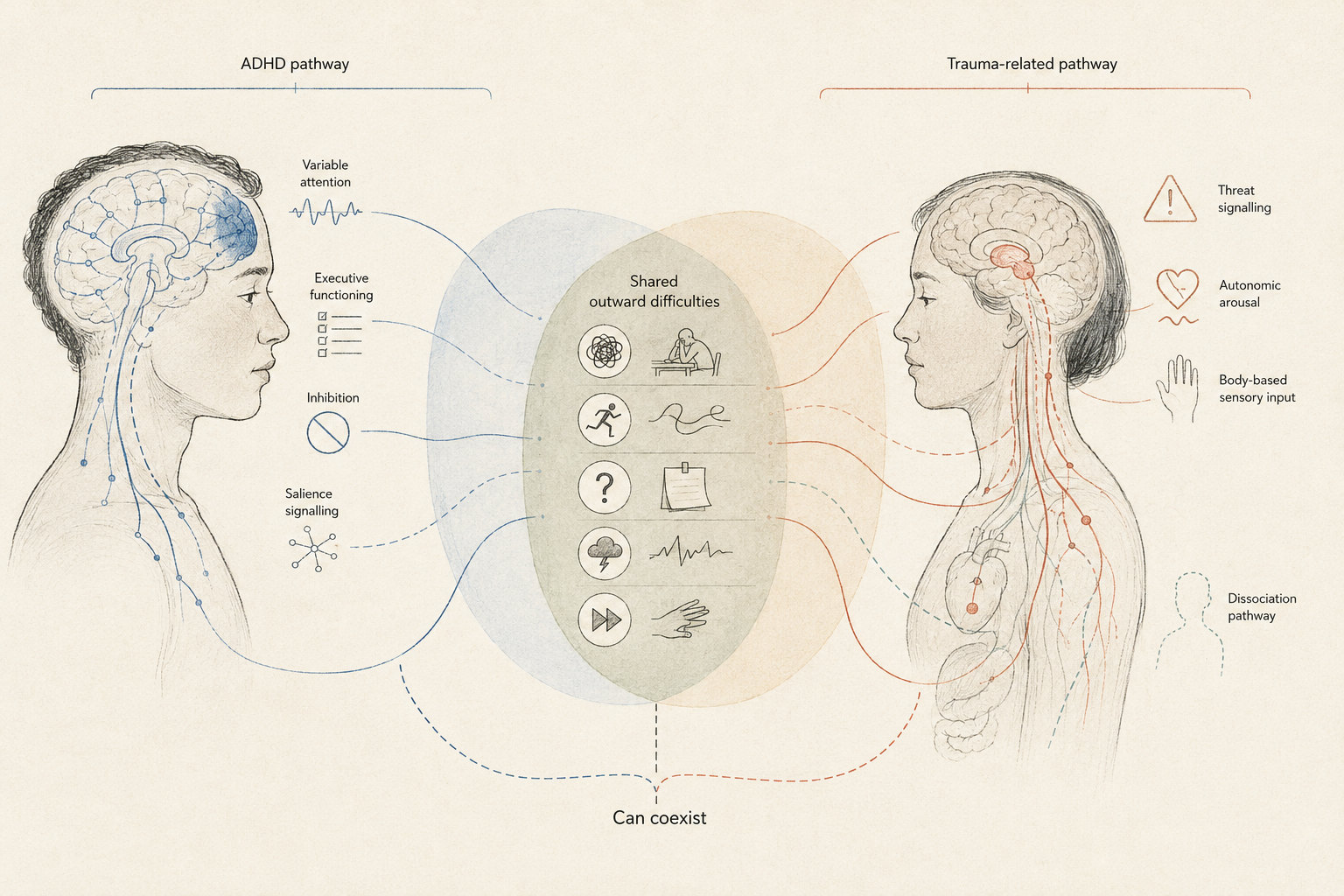
The same difficulties can have different causes. ADHD and trauma can both affect attention, memory, alertness and emotions. They can also occur together. That’s why looking at the symptoms alone cannot tell us where they come from or whether someone has ADHD, trauma, or both.
What the trauma research actually shows
Childhood adversity and ADHD are strongly associated. This is easy to spot in large pools of data, like the study by Zhang and colleagues. ² This meta-analysis of 70 studies involved nearly four million participants and found that people exposed to adverse childhood experiences were more likely to be diagnosed with ADHD, with the association becoming stronger as the number of adverse events increased. That is a crucial finding, but an association cannot by itself tell us which condition came first or what produced what, particularly because the studies were overwhelmingly observational. There’s no ethical way that you could expose someone to trauma to figure out whether ADHD was more or less likely to be diagnosed later in life, which is also an important consideration.
A more focused systematic review included 11 prospective longitudinal studies using criteria designed to figure out whether cause-effect links actually exist. ³ All 11 studies found an association between childhood maltreatment and ADHD, but the direction was inconsistent. Five suggested that maltreatment preceded later ADHD symptoms or diagnosis; two found evidence that ADHD preceded maltreatment. The authors concluded that the relationship was real, while the direction and mechanisms remained unresolved.
Keeping research cute…
What the hell is a prospective longitudinal study?
In plain English, it’s a study that follows the same group of people forward through time.
Researchers collect information at the beginning, then check in again months or years later to see what changes or develops. For example, they might record children’s experiences at age five, then assess ADHD symptoms at ages eight and twelve.
Prospective means looking forward from the study’s starting point.
Longitudinal means following people over an extended period.
Prospective longitudinal studies are essential research tools because they gather information that can help establish what happened first, in this case, trauma or ADHD. The key thing to remember is that they do not automatically prove that one caused the other.
Oh, and because good science is nuanced, there is also evidence pointing the other way. For example, a large study using genetic data and comparisons between siblings found that people with a greater inherited tendency towards ADHD were more likely to develop PTSD later in life, but it found no consistent evidence that those whose genetic profile indicated higher susceptibility for PTSD automatically had an increased likelihood of having ADHD. ⁴
In any event, participants diagnosed with ADHD were more than twice as likely to develop PTSD as their siblings without an ADHD diagnosis. It is tempting to interpret this as “ADHD can cause PTSD”, but that’s not the case either. The research does, however, challenge the belief that trauma typically comes first and later produces ADHD. It also raises serious questions about the linear explanation associated with Gabor Maté’s work. If only it were so simple!
The most accurate conclusion is that trauma can increase ADHD symptom severity, create overlapping difficulties and complicate diagnosis, but current research has not established that trauma creates ADHD as a neurodevelopmental condition.

Science, story and nourishment for neurodivergent life, straight to your inbox.
Why ADHD may increase exposure to trauma
Some ADHD characteristics may place us in situations where harm becomes more likely. Impulsive decision-making, rapid trust, difficulty reading risk in the moment and the pull of novelty or intensity can all contribute. The irresistible appeal of an unfamiliar or exciting situation may temporarily outweigh a more distant sense of danger. This is a bit more precise than saying that ADHDers are simply “dopamine seeking”, as though dopamine were a substance we chase around the world.
Social experiences matter too. Years of criticism, exclusion or being told that our instincts are wrong can teach us to override discomfort. Neurodivergent masking may involve complying, appeasing or staying in situations long after our body has begun signalling that something feels unsafe. Oh, and to be absolutely clear, none of this transfers responsibility away from the person who harms, exploits or abuses someone.
While reading recent research on this topic, I came across a systematic review and meta-analysis involving more than one million people. It found that ADHDers had higher odds of experiencing intimate-partner violence and sexual violence. ⁵ In fact, the odds of experiencing sexual violence were 84% higher for ADHDers compared with people without ADHD. The authors were careful to say that the reasons behind this association are complex and that they remain unclear.
I was shocked by the findings of this study although, sadly, as a survivor of sexual abuse myself, I can see clearly that what the study highlights is vulnerability, not blame. Some ADHD characteristics and social experiences may leave us more exposed to unsafe situations, sometimes from an early age. The effects of criticism, masking, rapid trust and difficulty recognising danger in the moment may continue into adult life. None of that makes the harm our fault.
Where socioeconomic disadvantage fits
ADHD is more common among children growing up in less advantaged circumstances, but this does not mean that poverty causes ADHD. A review of 42 studies found this link in 35 of them. Overall, children from less advantaged backgrounds were around twice as likely to have ADHD, although the results varied considerably and no single aspect of disadvantage explained why. ⁶
When it comes to socioeconomic factors, several systems may operate at once. Material insecurity can increase family stress, exposure to adversity and the load placed on a developing nervous system. It can also intensify existing ADHD characteristics and reduce access to supportive environments. Parental ADHD may affect education, employment and household income while also contributing to genetic susceptibility. Additionally, supporting a child with unrecognised or poorly supported ADHD can, in turn, affect a family’s finances and relationships.
Recognition is socially patterned as well. Wealth can provide tutoring, flexible schooling, private assessment and enough practical support to conceal impairment. Disadvantaged families may face greater stress while encountering more barriers to thorough assessment and sustained care. The way people are identified and diagnosed may affect the figures, but it does not fully explain why so many studies have found the same link.
At any rate, socioeconomic conditions impact exposure, expression, recognition and outcome without turning ADHD into a product of poverty. That is why I volunteer for the Nutritious Minds Charity Trust, a charity founded by Dr Rachel Gow that aims to provide educational, nutritional, and behavioural support and services to low-income families and young people facing financial hardship or adversity. I also volunteer for the Body & Soul Charity, a London-based charity established in 1996 that aims to save lives and liberate individuals from the life-shortening effects of severe trauma, childhood adversity, and suicidality. They use a whole-person, community-based model to restore hope and promote long-term healing.
Continue the conversation in The Circle
These wider questions, including how trauma, inequality, access to support and neurodivergence become entangled, deserve more space than a single article can offer. They are exactly the kinds of topics we will examine in greater depth in The Circle, where research, lived experience and practical support can sit alongside one another without reducing complex lives to simple explanations. If you would like to be part of those conversations, you can find the membership options below.

Join a research and learning community for people living and working with neurodivergence. Your membership brings together current science, practical resources, lived experience and thoughtful conversation throughout the month. The Circle is still in its founding season. Founding Membership is £25 per month until 31 October 2026. If you join during this period, £25 remains your monthly rate for as long as your membership continues. From 1 November, new memberships will be £35 per month.
Healing trauma and treating ADHD can coexist
I keep thinking about the phrase that prompted me to write this article:
“I decided to heal myself rather than take medication.”
This one feels personal because I made a similar decision in 2022. I stopped taking my ADHD medication because I had convinced myself that, if I worked hard enough on the childhood trauma that had followed me for years, I might finally free myself from what I thought of as my ADHD symptoms.
Working through trauma has helped me enormously. It has helped me understand why my body can move so quickly into threat, why I have sometimes taken risks without recognising them as such, and why certain situations affect me so strongly. What it did not do was make my ADHD disappear, even though I gaslit myself into believing otherwise for a few months…
I had treated trauma work and ADHD treatment as competing explanations. Over time, I came to understand that I did not have to choose between them. I could work with what had happened to me while also supporting the nervous system and neurotype I had lived with since childhood.
People make different decisions about medication, and there are good reasons why someone may take it, stop it or decide that it is not right for them. Side effects, other health conditions, access, personal preference and individual response all matter. What concerns me is the idea that taking medication represents a failure to heal, or that working with trauma somehow proves that ADHD was never there.
The research gives us good reason to avoid that conclusion. A recent umbrella review brought together 221 analyses of ADHD treatments, drawing on randomised trials involving around 50,000 children, adolescents and adults. It found good evidence that several ADHD medicines reduce symptoms in the short term, although side effects vary and we still need better long-term evidence. ⁷ That emphasises the point that medication is neither a universal answer nor something that can be dismissed with a slogan. It is one possible form of support, to be considered properly with the person taking it alongside other measures.
Medication may also affect risks that reach well beyond concentration. As an example, a large Swedish study followed almost 149,000 people and found that starting ADHD medication was associated with lower rates of suicidal behaviour, substance misuse, transport accidents and criminality. ⁸ Because this was an observational study, it cannot prove that medication caused every reduction. But the findings still matter because they remind us that leaving ADHD untreated can carry risks too. I discuss ADHD meds and quality of life in detail in another article I wrote a few weeks ago.

ADHD meds: A solution or a bit of breathing space?
What living with both has taught me
I live with ADHD and with the lasting effects of childhood trauma. Sometimes I can tell which is affecting me, sometimes I cannot, and I am increasingly comfortable admitting that. Human lives do not divide themselves into the neat categories we use to study them.
Working with trauma has helped me understand my hypervigilance, my relationship with risk, the ways I have tried to regulate myself and some of the pain I have carried in my body. None of that erases the developmental patterns that have been present across different settings and stages of my life.
A careful assessment leaves room for the whole person. It looks at what was there early, what becomes stronger when the person feels threatened, what changes as trauma is processed and what continues. Support can then change alongside the person, without asking them to choose between making sense of their history and respecting how their brain works.
The person whose video prompted this article has every right to tell their story and describe what helped them. Their experience may help other people ask useful questions about their own lives. The difficulty comes when one person’s explanation is turned into an answer for everybody else.
A personal story can open an important conversation. It should not be used to close down everybody else’s.
With love and gratitude,

Some of the science on trauma and ADHD
Annotated by yours truly
Magdi, H. M., Abousoliman, A. D., Ibrahim, A. M., Elsehrawy, M. G., El-Gazar, H. E., & Zoromba, M. A. (2025). Attention-deficit/hyperactivity disorder and post-traumatic stress disorder adult comorbidity: a systematic review. Systematic reviews, 14(1), 41. https://doi.org/10.1186/s13643-025-02774-7
I like this review because it helps explain why separating ADHD from trauma is not always straightforward. Across the studies included, reported rates of ADHD and PTSD occurring together ranged from around 28% to 36%, and living with both was linked with greater difficulties. Because much of this evidence came from clinical and military groups, these figures should not be applied to the general population.
Zhang, N., Gao, M., Yu, J., Zhang, Q., Wang, W., Zhou, C., Liu, L., Sun, T., Liao, X., & Wang, J. (2022). Understanding the association between adverse childhood experiences and subsequent attention deficit hyperactivity disorder: A systematic review and meta-analysis of observational studies. Brain and behavior, 12(10), e32748. https://doi.org/10.1002/brb3.2748
This very large review brought together 70 studies involving nearly four million people. ADHD was more common among those who had experienced childhood adversity, particularly when several adverse experiences had accumulated, but these findings cannot tell us that adversity caused the ADHD.
Bali, P., Sonuga-Barke, E., Mohr-Jensen, C., Demontis, D., & Minnis, H. (2023). Is there evidence of a causal link between childhood maltreatment and attention deficit/hyperactivity disorder? A systematic review of prospective longitudinal studies using the Bradford-Hill criteria. JCPP advances, 3(4), e12169. https://doi.org/10.1002/jcv2.12169
I chose this review because it asked the central question directly, i.e., does childhood maltreatment cause ADHD? Across 11 studies that followed people over time, the researchers found a clear relationship between maltreatment and ADHD, but could not establish that one caused the other. Some studies suggested that maltreatment came first, while others found that ADHD preceded maltreatment. This uncertainty is important because it shows why a strong association should not be presented as proof of causation.
Wendt, F. R., Garcia-Argibay, M., Cabrera-Mendoza, B., Valdimarsdóttir, U. A., Gelernter, J., Stein, M. B., Nivard, M. G., Maihofer, A. X., Post-Traumatic Stress Disorder Working Group of the Psychiatric Genomics Consortium, Nievergelt, C. M., Larsson, H., Mattheisen, M., Polimanti, R., & Meier, S. M. (2023). The Relationship of Attention-Deficit/Hyperactivity Disorder With Posttraumatic Stress Disorder: A Two-Sample Mendelian Randomization and Population-Based Sibling Comparison Study. Biological psychiatry, 93(4), 362–369. https://doi.org/10.1016/j.biopsych.2022.08.012
This study used genetic information and comparisons between siblings to try and figure out which condition might tend to come first. People with ADHD were more than twice as likely to develop PTSD as their siblings without ADHD, while the researchers found no consistent evidence that a genetic tendency towards PTSD increased the likelihood of ADHD.
Arrondo, G., Osorio, A., Magallón, S., Lopez-Del Burgo, C., & Cortese, S. (2023). Attention-deficit/hyperactivity disorder as a risk factor for being involved in intimate partner violence and sexual violence: a systematic review and meta-analysis. Psychological medicine, 53(16), 7883–7892. https://doi.org/10.1017/S0033291723001976
I included this review because it challenges the assumption that trauma must always come before ADHD. Across studies involving more than one million people, those with ADHD had a greater likelihood of experiencing intimate-partner and sexual violence. In fact, the odds of sexual victimisation were 84% higher, which is a shocking statistic. As I mentioned above, “the moral” of the study is not blame, but vulnerability. The authors spell out how their findings could easily be misinterpreted, and I can see why through the lens of my own lived experience. Things are messy and complex when we combine a nervous system that diverges from “the norm” for more than one reason…
Russell, A. E., Ford, T., Williams, R., & Russell, G. (2016). The Association Between Socioeconomic Disadvantage and Attention Deficit/Hyperactivity Disorder (ADHD): A Systematic Review. Child psychiatry and human development, 47(3), 440–458. https://doi.org/10.1007/s10578-015-0578-3
In 35 of the 42 studies reviewed, childhood ADHD was more common in families facing socioeconomic disadvantage. This deserves attention because financial pressure, family stress, inherited ADHD traits, unequal access to support and the effects of unsupported ADHD may all feed into one another. In any case, poverty alone cannot be treated as a simple cause for ADHD, and that’s clear from this paper.
Gosling, C. J., Garcia-Argibay, M., De Prisco, M., Arrondo, G., Ayrolles, A., Antoun, S., Caparos, S., Catalán, A., Ellul, P., Dobrosavljevic, M., Farhat, L. C., Fico, G., Eudave, L., Groenman, A. P., Højlund, M., Jurek, L., Nourredine, M., Oliva, V., Parlatini, V., Psyllou, C., … Cortese, S. (2025). Benefits and harms of ADHD interventions: umbrella review and platform for shared decision making. BMJ (Clinical research ed.), 391, e085875. https://doi.org/10.1136/bmj-2025-085875
This wide-ranging review gives us a balanced account of ADHD treatment. It found good evidence that several medicines reduce ADHD symptoms in the short term, while side effects, individual response and the shortage of strong long-term evidence still need to form part of an honest conversation.
Zhang, L., Zhu, N., Sjölander, A., Nourredine, M., Li, L., Garcia-Argibay, M., Kuja-Halkola, R., Brikell, I., Lichtenstein, P., D'Onofrio, B. M., Larsson, H., Cortese, S., & Chang, Z. (2025). ADHD drug treatment and risk of suicidal behaviours, substance misuse, accidental injuries, transport accidents, and criminality: emulation of target trials. BMJ (Clinical research ed.), 390, e083658. https://doi.org/10.1136/bmj-2024-083658
Among nearly 149,000 people in Sweden, starting ADHD medication was associated with lower rates of suicidal behaviour, substance misuse, transport accidents and criminality. This kind of study cannot prove that medication caused every reduction, but it shows why dismissing treatment as the opposite of “healing” may deny people an intervention with potentially important protective benefits.