Five student research projects exploring how we eat, feel and live
I love lecturing and being in touch with students from all different nationalities, ages, and walks of life. Some of the most rewarding conversations I have with them begin with curiosity, something they have noticed in practice, experienced themselves or encountered in the research, but do not yet know how to investigate. An important part of my supervision is helping them turn that curiosity into a focused, ethical and achievable research question. And I find that absolutely thrilling.
At the University of West London, I co-lead the Research Methods module and am module leader for Quality Improvement for Health and Wellbeing within the MSc Nutrition, Health and Wellbeing. This year, several of the projects I supervise connect with an area that has occupied much of my own work, namely how neurotype, gut–brain signalling, sensory experience, capacity and everyday circumstances shape the ways we eat and feel.
Several students are now recruiting, and they would be very grateful for your help. I would also be very grateful if you took part in any of the studies for which you are eligible.

The research beneath the research
Across these five projects, several use or adapt research tools I have been developing, while others explore closely related questions.
PHOCUS examines eating through six connected areas: patterns, hunger and interoception, options, capacity, underlying neurobiology and sensory experience. You already know PHOCUS from my recent masterclass and the PHOCUS Eating Map.
GBANI, the Gut–Brain Axis Nutrition Index, looks at eating patterns relevant to gut–brain health, including fibre, plant variety, fermented foods, fats, eating rhythm and whether foods are practically and sensorially manageable.
NOURISH brings in broader areas such as digestive comfort, emotional load, resilience, sleep and self-described neurotype.
These are developmental research measures, rather than diagnostic or clinical assessment tools.
Several of the projects also include a brief neurotype section that I developed as part of NOURISH. This allows us to look for possible patterns without requiring participants to have a formal diagnosis.
Together, these tools sit within a developing programme called NEEM, the shortest version of the acronym I could think of to describe the Neurodivergent Ecology of Eating and Microbiome-Mediated Gut–Brain Regulation. I will be taking this work forward at Cardiff University through my role as an Honorary Research Fellow in the School of Psychology. The planned pathway begins with a conceptual paper and preliminary cross-sectional psychometric studies, followed by more formal validation and the development of shorter versions of the tools. Longitudinal and intervention research may follow as the evidence develops over the next 3 years.
These MSc studies provide valuable early exploratory work, aka “testing the waters” and helping me refine the language and implementation of the questionnaires in an academic research setting that crosses over into the real world. They also allow me and my students to see how the tools behave when applied to different questions and groups of people, something that I find utterly fascinating!
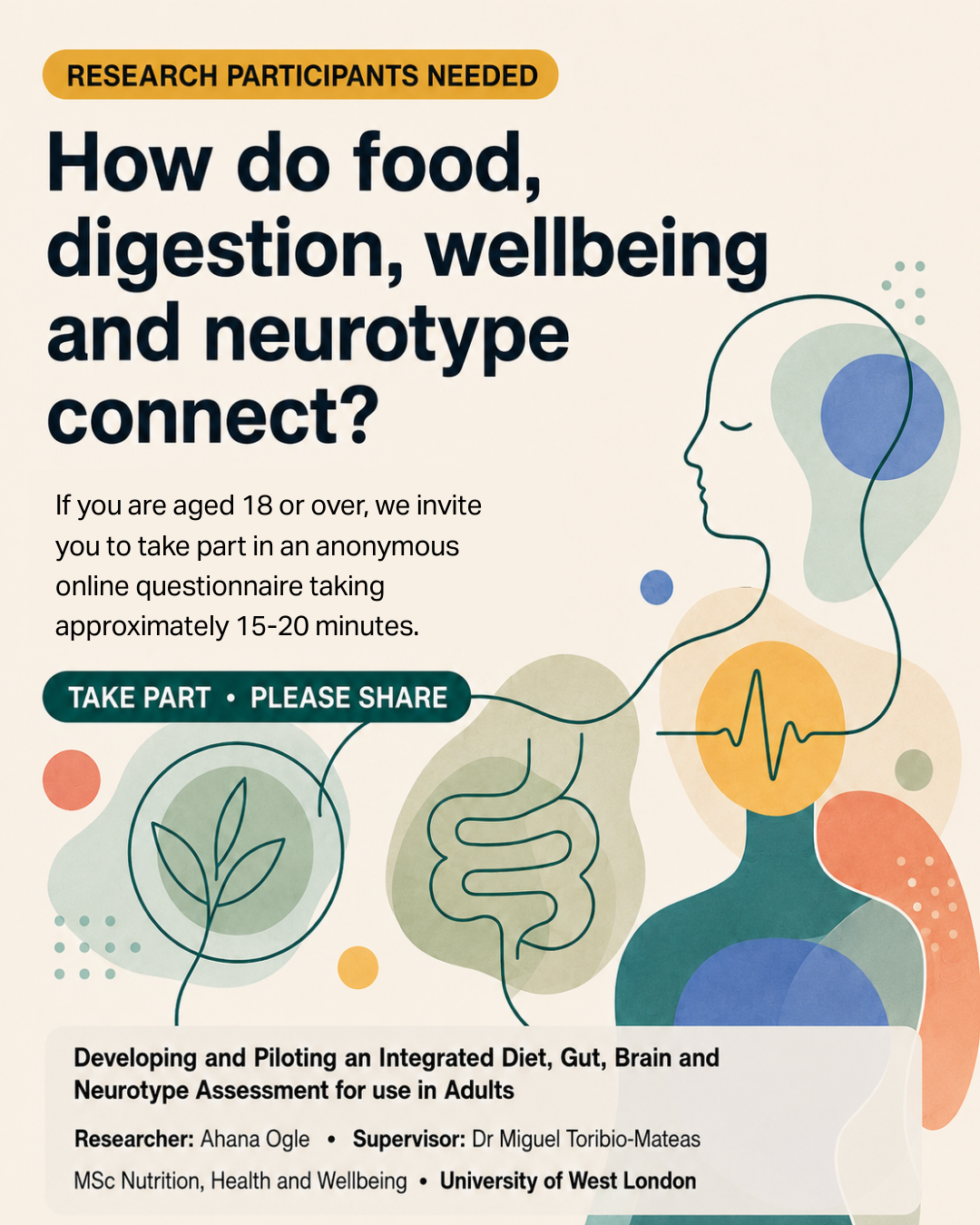
Ahana Ogle: bringing food, digestion, wellbeing and neurotype together
Ahana is testing a questionnaire that brings together two research tools I have been developing, NOURISH and GBANI. It asks about food choices, digestive health, sleep, stress, resilience and neurotype, meaning the different ways our brains process and respond to the world.
Her study will help us see whether the questions work well together, how manageable the questionnaire feels and what needs improving before we use it in larger studies.
As an autistic ADHDer, my gut, appetite, sensory system and executive functions do not always seem to be reading the same memo. I can know exactly which foods may support my gut–brain health and still miss hunger signals, rely on familiar foods, or find that texture, preparation demands and available capacity make the theoretically “best” choice inaccessible that day. That space between knowing and being able to act is central to my work, and one reason Ahana’s project feels especially personal.
You can take part if you’re aged 18 or over. All neurotypes are welcome. Your experience is relevant whether you identify as neurodivergent or neurotypical, relate to some neurodivergent characteristics or are unsure how you would describe your neurotype. No formal diagnosis is required.
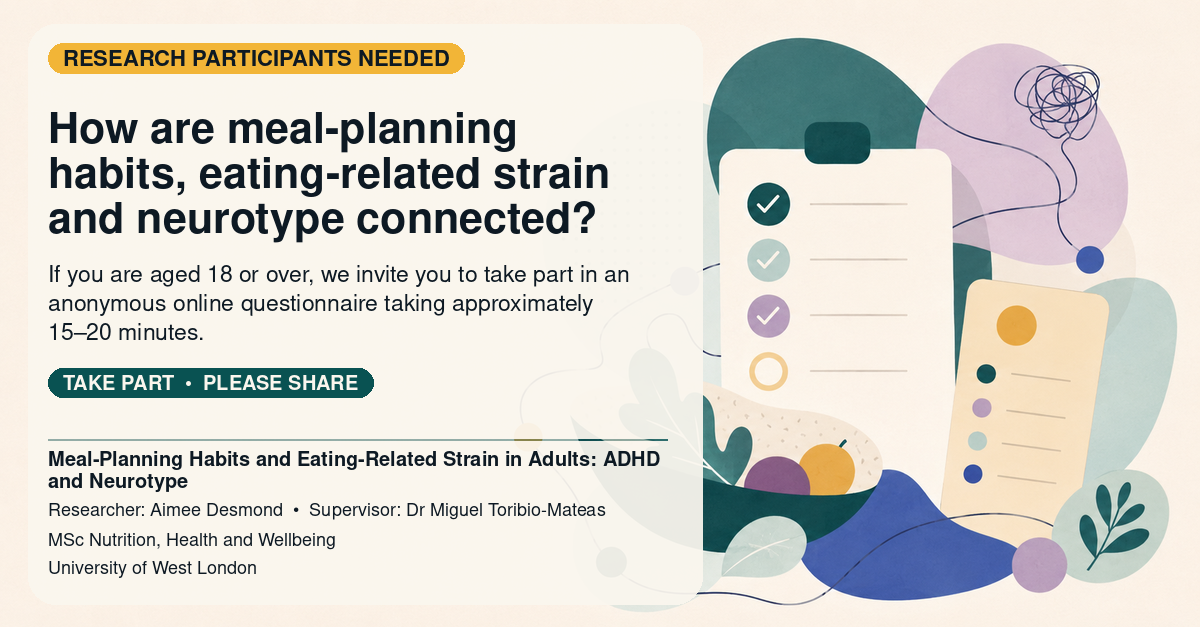
Aimee Desmond: meal planning, eating and neurotype
Planning meals can be much harder than it sounds. It involves making decisions, remembering what you need, managing time and energy, and finding foods that work for you practically and sensorially.
Aimee is using PHOCUS alongside questions about meal-planning habits to study how people plan meals and whether this is connected with stress or difficulty around eating. She is also looking at whether people with different neurotypes, including ADHD, experience meal planning differently.
Meal planning and I have a turbulent relationship. I can make a beautifully sensible plan on Sunday, then discover by Tuesday that my energy, appetite, sensory needs or capacity are completely different, so the plan no longer works… That is why this project connects so closely with the work I’ve been doing on NEEM, and the fact that eating emerges from the interaction between neurotype, body signals, environment and available resources, rather than organisational skill alone.
If you’re interested in this topic and are an adult aged 18 or over, please complete Aimee’s anonymous online questionnaire. She is particularly interested in ADHD, which is really cool!
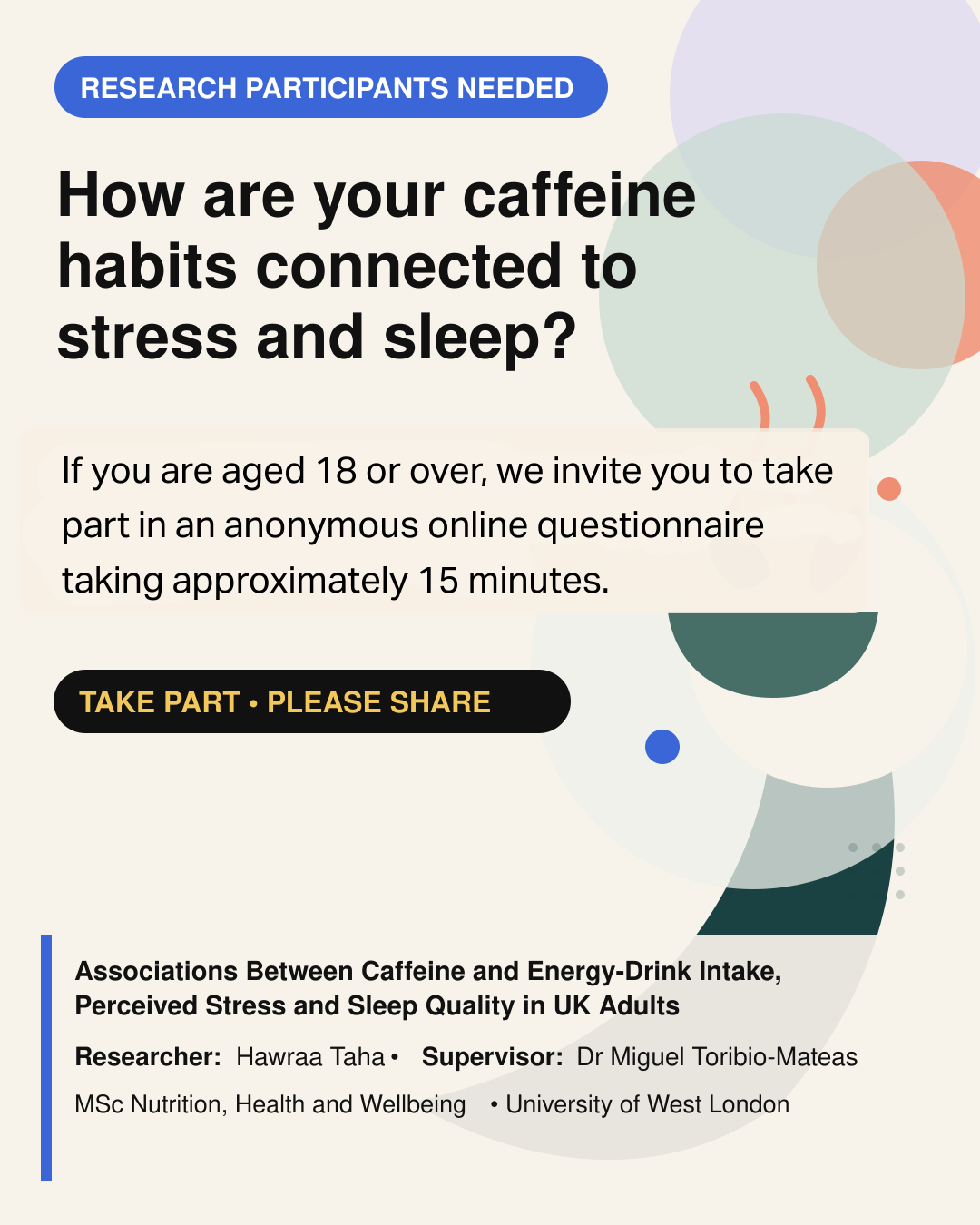
Hawraa Taha: caffeine, energy drinks, stress and sleep
Hawraa is looking into the associations between caffeine and energy-drink intake, perceived stress and sleep quality.
Caffeine can be used for alertness, concentration, pleasure, routine or compensation for insufficient sleep. Its relationship with stress and sleep is therefore unlikely to be explained by intake alone. Hawraa’s study will examine how these factors appear together in adults of different neurotypes.
Personally, I am so sensitive to caffeine that two espressos might have me dancing on a table. Yet I know many ADHDers who say coffee helps them feel calmer or focus more easily, and some can drink it just before bed. Those very different experiences are why Hawraa’s study matters. We need to understand more about how caffeine, neurotype, stress and sleep relate, without assuming that the same intake affects everyone in the same way. If this resonates with you and you’re over 18 years of age, please complete Hawraa’s anonymous survey now.
Adeen Afzal Qureshi: social media, influencer exposure and food-related self-perception
Adeen’s project focuses on how social-media use and exposure to influencer content may relate to the way young adults think and feel about food.
This includes more than direct nutritional advice. Online content can shape expectations about eating, bodies, health and what constitutes an acceptable or desirable food choice. Adeen’s research examines these relationships carefully without assuming that social media affects everyone in the same way.
My relationship with social media is complicated. I genuinely love the connection, creativity and opportunities it brings, but I also catch myself comparing my real life with other people’s carefully edited versions of theirs. Even when you understand how influence works, it is easy to absorb food and health messages that serve someone else’s brand, priorities or commercial interests, which is why Adeen’s question feels so relevant.
This study is designed for adults aged between 18 and 30. If you don’t meet the age criterion, please do share it with anyone who does and invite them to complete Adeen’s anonymous online survey. Thank you!

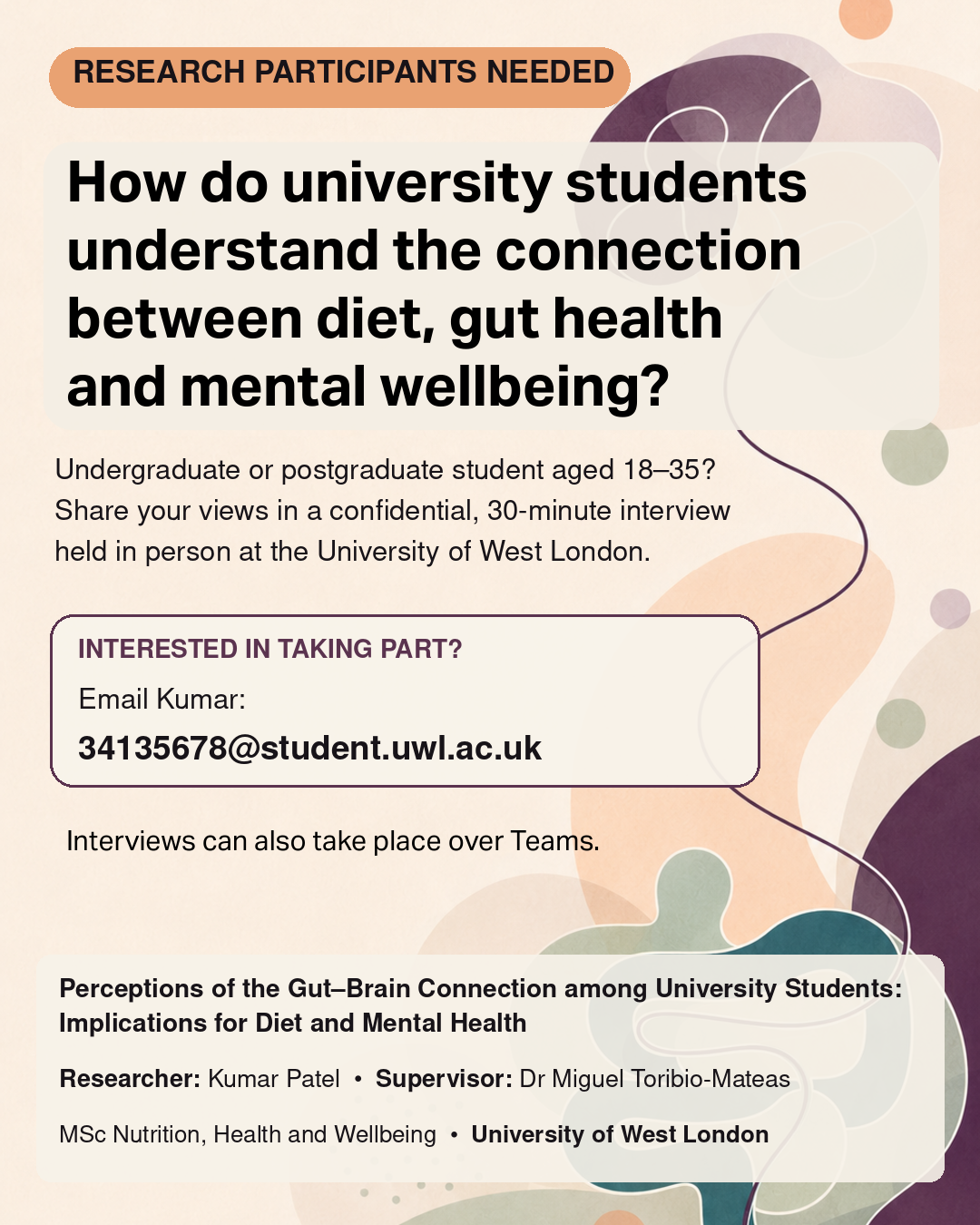
Kumar Patel: how students understand the gut–brain connection
Kumar is taking a qualitative approach, speaking directly with university students about how they understand the connections between diet, gut health and mental wellbeing.
After almost two decades working at the intersection of gut–brain science and mental health, I have watched this field move from the margins into everyday conversation. That visibility is welcome, but complex evidence can quickly become flattened into claims that a single food, microbe or supplement will “fix” mental health. Kumar’s interviews interest me because responsible communication begins with understanding what people already believe, where those ideas came from and what may be missing.
If you’re an undergraduate or postgraduate university student aged 18 to 35, you can participate in a confidential 30-minute interview, either at UWL or through Microsoft Teams. If you don’t meet this criterion but know someone who does, please share and invite them to contact Kumar to arrange an interview.
To express an interest, please email Kumar at 34135678@student.uwl.ac.uk or click on the button below.
Could you support this work?
These are student-led projects, but they also contribute to a wider research culture in which nutrition is considered in relation to behaviour, capacity, sensory experience, social influences, mental wellbeing and the gut–brain axis.
If you meet the criteria for one or more studies, I would be very grateful for your participation. You can also help by sharing this article or the individual research links with friends, family, neighbours, and anyone else in your networks.
Good student research begins with a carefully framed question. It also depends on people like you being willing to give their time and share their experiences. Thank you for helping this next generation of nutrition researchers develop their skills and contribute to the evidence base.
With gratitude,