Jump to recipe ↓ Why it’s interesting nutritionally ↓ The science behind the recipe ↓
I used to make a version of this loaf years ago with oat, buckwheat and barley flakes, grated vegetables, seeds and eggs. I always called it bread, although nobody was going to mistake it for a baguette. It was dense, moist, extremely filling and somewhere between bread, a savoury cake and a meal you could hold in your hand.
When I became vegan, I wanted to make it again. The interesting bit was working out what the eggs had actually been doing. They provided moisture, protein and, importantly, enough structure to hold a fairly unruly collection of grains, seeds and vegetables together. Simply removing them wasn't going to work.
So this version uses several ingredients that do slightly different jobs: chia and flax develop mucilage when hydrated; psyllium forms a strong gel; chickpea flour sets as it cooks; and part of the cereal flakes are ground to give the mixture a more continuous structure. A little yeast and baking powder lighten things without trying to turn this into conventional bread.
My first vegan batch was genuinely delicious. The combination of green olives, peanuts and doenjang gave it a deep savoury quality that I hadn't quite anticipated. It was also a little crumbly. Rather than hiding that, I've used it to make the recipe below slightly better.
The recipe
This makes a substantial batch, approximately one large and one smaller loaf. You can also divide it between two medium loaf tins. I prefer different size slices because I’m a bit whimsical like that… :)
Ingredients
Grains and binders
120 g oat flakes
90 g buckwheat flakes
70 g barley flakes
40 g spelt flakes
60 g chickpea flour
20 g ground flaxseed
20 g chia seeds
20 g psyllium husk
1 tsp baking powder
5 g dried active yeast, approximately 1½ tsp
1 tsp sugar or maple syrup to activate the yeast
½ tsp sea salt, or less if your doenjang and olives are particularly salty
Seeds, nuts, and vegetables
70 g pumpkin seeds (50 g in the dough and 20 g for decoration)
80 g red-skin peanuts, roughly chopped
150 g courgette, grated and gently squeezed
120 g carrot, grated
100-120 g tomato, finely chopped and drained of excess juice
100 g pitted green olives, well drained. You can chop them, but I prefer them whole because they look pretty when you slice them.
2 tbsp dried mixed herbs. I make my own mix with parsley, sage, basil, oregano, marjoram, and thyme.
1 tbsp doenjang, about 15 g
Liquid
2 tbsp extra virgin olive oil
90 ml water for the chia
100 ml warm unsweetened soya milk for the yeast
Additional unsweetened soya milk, as needed. I ended up using another 200ml.
Optionals
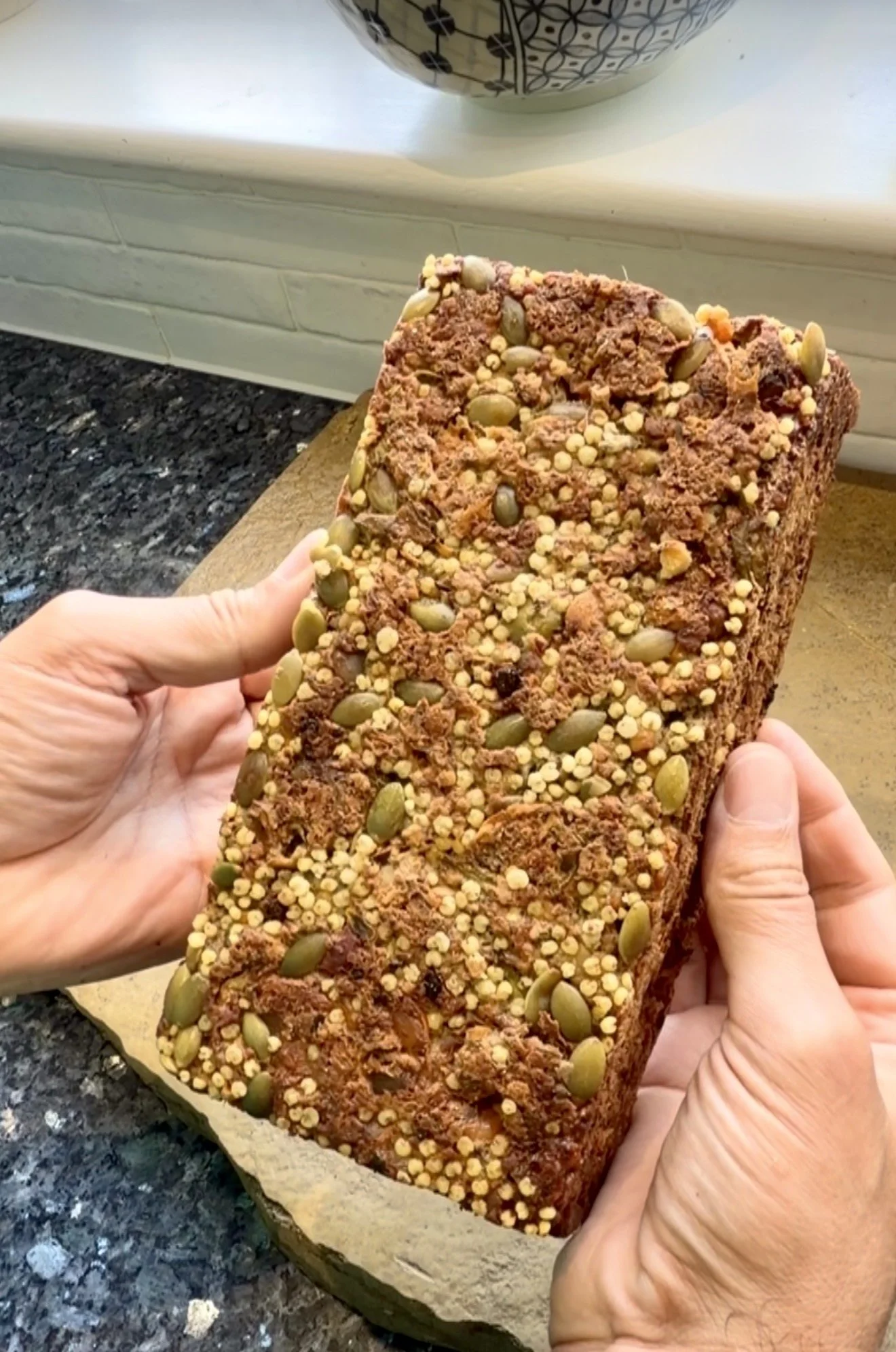
Additional seeds to decorate the top of the loaf. I used some more pumpkin seeds and some puffed millet, which looks gorgeous 😍 Oh, and I ended up adding a handful of rocket that needed using. No food waste here!
Onion powder, black pepper, and other herbs. There is already quite a lot happening flavour-wise.
Method
Here’s my step-by-step method. It feels like a lot, but once you’ve made your first loaf, you’ll pretty much go on auto-pilot.
Start by mixing the chia seeds with 90 ml water. Leave them for about 10-15 minutes. They should become noticeably gelatinous.
Meanwhile, combine the yeast, sugar and 100 ml warm soya milk. You want the milk comfortably warm rather than hot. Leave this for around 10 minutes until you can see some activity.
Take approximately 100 g of the combined oat, barley and buckwheat flakes and blitz them into a coarse flour. Keep the remaining flakes whole. This is one of the changes I would make after my first attempt because it should help the loaf hold together without sacrificing its characteristic texture.
Line your loaf tins properly with baking parchment. I now consider this part of the recipe rather than an optional act of optimism. Ideally, run the paper across the base and up the long sides so that you can eventually lift the loaf out. Lightly grease any exposed ends of the tins with olive oil or vegan butter. I will be posting a recipe for this very soon! You can also use a silicone loaf tin. I’ve just bought a couple, so I’ll be using that going forward.
Mix the whole flakes, ground flakes, chickpea flour, flax, psyllium, baking powder and salt.
Give your pumpkin and red skin peanuts a quick grind so they distribute better in the dough.
Fold in the courgette, carrot, tomato and olives.
Stir the doenjang into some of the remaining soya milk so that it disperses evenly. Add this, the chia gel and the activated yeast mixture to the bowl. Start with about 150 ml additional soya milk and mix thoroughly. Leave the mixture for 10 minutes before deciding that it needs more. Psyllium, chia, flax and the flakes all continue absorbing water.
You are aiming for a very thick, cohesive mixture that can be spooned rather than poured. If you drag a spoon through it, the channel should slowly begin to close. Add more soya milk in 20-30 ml increments if it still seems dry.
Transfer to your tin(s), pressing the mixture into the corners and removing obvious air pockets without compacting it excessively.
Leave somewhere warm for 45-60 minutes. You may see a little expansion and aeration, but this heavy mixture isn't going to double in size. Just setting realistic expectations!
Bake at 170°C fan / 185°C conventional.
For a smaller loaf, start checking at about 40 minutes and expect around 50 minutes. The larger loaf will probably need 55 to 65 minutes. A skewer should come out without wet batter attached, although a few moist crumbs are perfectly reasonable in a vegetable-heavy loaf.
Leave the baked loaf in its tin for at least 30 minutes before attempting to remove it. Then lift it out using the parchment. If it feels sufficiently firm, remove the paper and return it directly to the oven rack for another 8–12 minutes to dry the sides and base.
Finally, let it cool completely, preferably for at least two hours, before slicing. The crumb continues setting as the chia, flax, psyllium and starches cool.
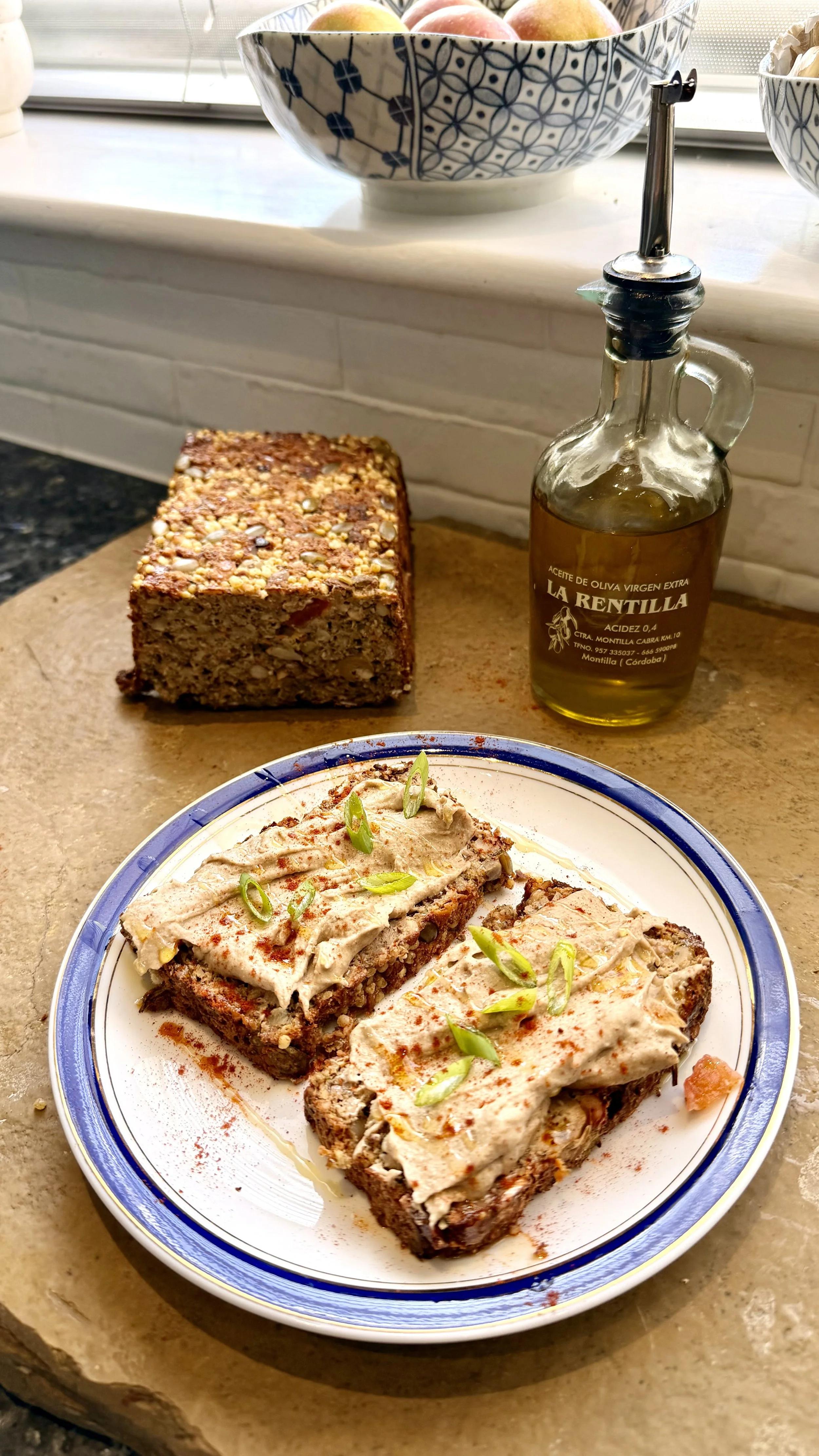
The bread goes beautifully with my butter bean, red peanut and miso pâté, which I’ll be sharing here very soon…

Science, story and nourishment for neurodivergent life, straight to your inbox.
Field notes from the first batch
The first version taught me quite a lot. I used more soya milk than I had originally anticipated. That makes sense because the exact hydration needed is going to change with the flakes and, particularly, with the water content of the courgette and tomato. I would therefore keep the final amount of soya milk deliberately flexible.
I also added 100 g green olives and a tablespoon of doenjang on impulse. I'm very glad I did. They turned what could have been a fairly worthy-tasting seed loaf into something much more interesting. There is a lovely savoury, fermented depth to it.
The loaf was slightly crumbly. I think several things contributed. I hadn't ground any of the flakes, which meant there were lots of relatively large particles with fewer continuous surfaces holding them together. The olives introduced additional moisture and more physical interruptions in the crumb. And 15 g of psyllium, while sufficient to bind it, probably wasn't quite enough for everything I subsequently threw into the bowl.
So this version uses 20 g psyllium and 100 g of the flakes ground into coarse flour. I wouldn't push the psyllium much further initially because too much could take the texture from substantial to rubbery.
Another useful lesson is that recipes like this are never completely reducible to numbers. A courgette is not a standardised laboratory reagent. Some are full of water, some much less so. The same applies to tomatoes. Learning what the mixture should feel like is ultimately more useful than pretending that 327 ml of soya milk will be correct every time. And there’s also my ADHD brain and the last-minute additions, like the olives, which can either make a recipe pop or they can make it fail. But hey, sometimes a good recipe needs a bit of ADHD-style risk taking! :)

What is interesting about it nutritionally?
There is a lot of fibre here, but what interests me more is the diversity of fibres.
Oats and barley contribute β-glucans, soluble polysaccharides with some of the strongest human evidence among cereal fibres. At intakes around 3 g per day, oat β-glucan has been shown in randomised trials and meta-analyses to reduce LDL cholesterol. I wouldn't assume that a slice of this loaf delivers the clinical dose used in those studies, but it certainly contributes towards intake.
The microbial story is interesting too. Human studies with whole-grain barley and oat β-glucans have reported changes in microbial fermentation and short-chain fatty acids, alongside changes in taxa including lactobacilli and, in one barley intervention, Roseburia hominis. A broader systematic review of whole grains and dietary fibres found evidence of increases in bifidobacteria and lactobacilli across some interventions, although responses varied considerably between studies.
That variability matters. I wouldn't describe barley as something that simply “feeds Roseburia” or oats as a guaranteed bifidogenic food. Microbial ecology is much more contextual than that. Your baseline microbiome, habitual diet, dose, food structure and interactions with other organisms all influence what happens in your gut compared to anyone else’s.
The chickpea flour, vegetables and whole grains contribute additional fermentable carbohydrates. Chia and flax provide mucilage as well as insoluble and fermentable fibres. Psyllium behaves somewhat differently. Much of its usefulness comes from its physical ability to bind water and form a viscous gel rather than from being enthusiastically fermented by the microbiota. But then again, having different types of fibre doing different things is one of the aspects I like about this loaf.
Flax brings another interesting microbial interaction through its lignans. Gut organisms transform plant lignans into compounds including enterodiol and enterolactone, but people vary markedly in their ability to perform that conversion. Human intervention work has linked lignan metabolism with different microbial communities rather than identifying one universal “lignan bacterium”.
Then there are the polyphenols and other phytochemicals from the grains, peanuts, flax, vegetables and olives. Many dietary polyphenols reach the large intestine, where microbial metabolism can transform them into smaller compounds that may be more biologically available. Clinical research increasingly supports this two-way relationship between polyphenols and microbial ecology, but the response is strongly individual. Recent reviews have found associations with organisms such as Bifidobacterium, Akkermansia and Faecalibacterium in some interventions, although that does not mean this particular loaf can be expected to increase those bacteria.
The flax and chia also make this a useful source of alpha-linolenic acid, the essential plant omega-3 fatty acid, while the chickpea flour, soya milk, peanuts and other seeds bring the protein to a respectable level.
The doenjang deserves a small caveat. It is a fermented soybean food with a stronger, almost “jamón serrano-like” umami flavour. But after spending an hour in the oven I wouldn't describe the finished loaf as probiotic. Its microorganisms are unlikely to survive baking. What remains useful nutritionally are the soybean components and, perhaps most importantly for this recipe, its extraordinary ability to make things taste good.
From a gut-brain perspective, fibres, polyphenols and the microbial metabolites generated from them are genuinely interesting because short-chain fatty acids and other microbial products participate in intestinal, immune, metabolic and neuroendocrine signalling. The evidence becomes much less certain when we try to turn those mechanisms into claims about mood, cognition or ADHD. I prefer to stay with what we can actually substantiate. Quite plainly, this loaf brings together a remarkably varied collection of substrates for the gut microbiota alongside useful protein, essential fats and micronutrients. The rest is a bonus…
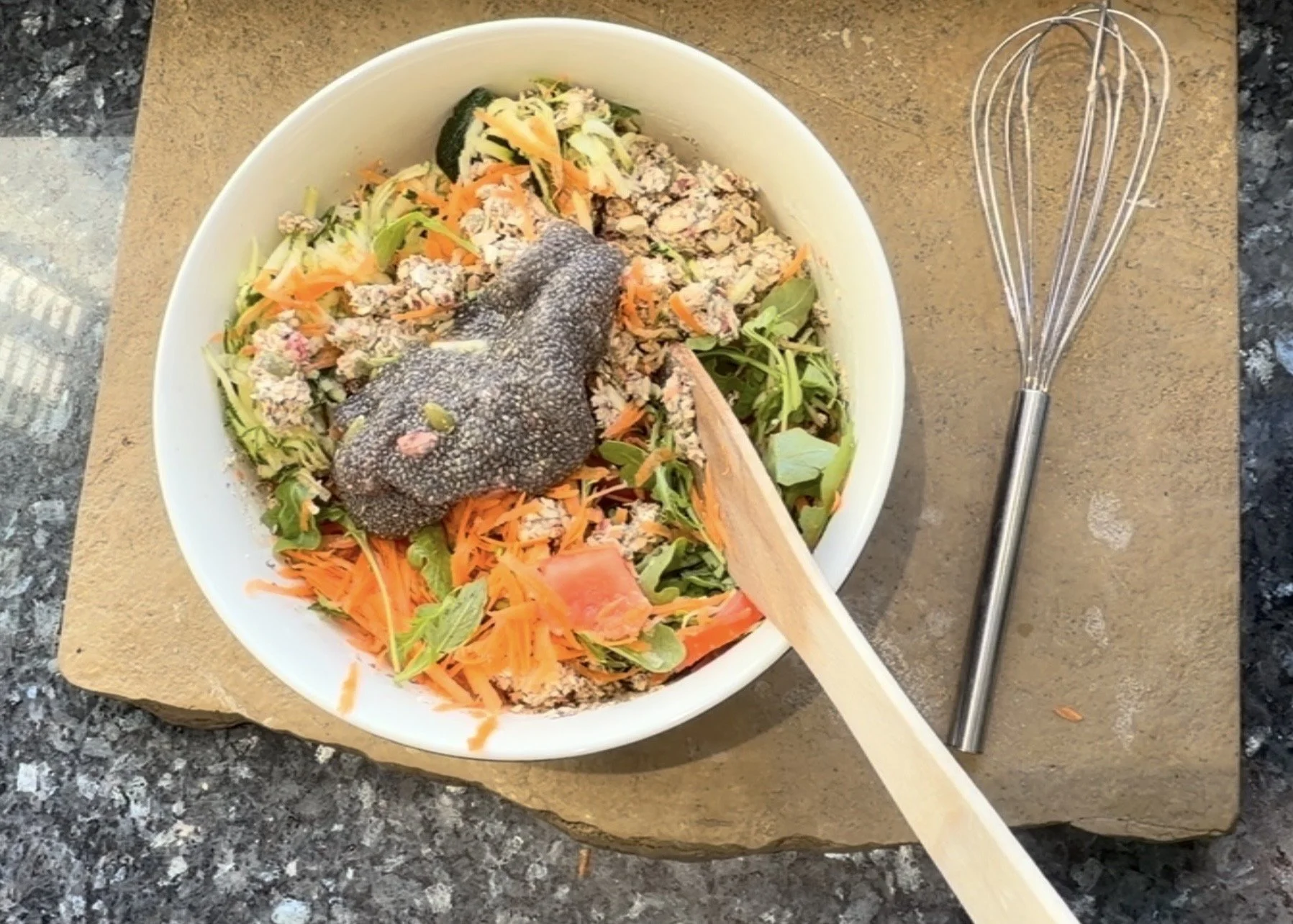
With this amount of ingredients and no eggs to bind, at this point, I had stopped making bread and started conducting a small experiment in edible structural engineering… Such fun! 🤩
Approximate nutrition
Using generic UK food-composition values, including the 100 g green olives, 15 g doenjang and approximately 400 ml unsweetened soya milk, and based on my cooled batch, which weighed 1.4 kg, these are my estimates:
Approximate amount per 100 g
Per 100 g: 225 kcal, 9 g protein, 24 g carbohydrate, 11 g fat, 7 g fibre.
Per 2 slices, about 130 g: 290 kcal, 12 g protein, 31 g carbohydrate, 15 g fat, 9 g fibre.
My calculations use generic ingredient composition data of the kind compiled in the UK CoFID database, but these figures are estimates rather than laboratory analysis. The biggest variable is the final baked weight because water lost in the oven changes the values per 100 g considerably. At roughly 9 g fibre per 2 slices, this is genuinely a high-fibre food rather than simply a loaf with a few seeds scattered over the top.
Storage
Once completely cool, store the loaf in an airtight container in the fridge and eat within 3-4 days. For longer storage, slice and freeze for up to 3 months. Reheat slices in the toaster, oven, air fryer or frying pan. Avoid wrapping the loaf while it is still warm, as trapped condensation can make it spoil more quickly.
Food, values and why making this felt different
There is another layer to this recipe for me now. I have cooked with grains, vegetables, seeds, and pulses for decades, so none of the ingredients feels particularly new. What has changed is the meaning attached to choosing them.
Since deciding to live vegan, cooking has started to feel like one of the places where my values become tangible. I can care about animals in the abstract, but I can also stand in my kitchen and make supper in a way that asks less of them. There is something satisfying about that correspondence between what I believe and what I actually do, and that makes me feel happy.
I don't experience it as purity, and I don't think every meal needs to carry a moral message. I still want bread to be delicious. I want the crust, the olives, the savouriness of the doenjang and the roasted peanuts. I’ve only just discovered the doenjang recently and I am obsessed with it, so I am putting a lot of emphasis on sensory pleasure.
But I feel that making food can also become a small daily practice of attention and compassion. For me, that is where some of the spirituality of veganism sits. It is grounded in ordinary choices rather than grand statements. The awareness of what I buy, what I cook, what I eat, and what I choose to leave out are part of the presence I am trying to cultivate and, in this particular case, what came out of the oven happened to taste rather wonderful too.
With love and lots of umami,

The Science
Here’s the science behind this recipe, although the pleasure of enjoying it is the main thing you should preoccupy yourself with…
Adorno Vita, A., Brown, J., Norby-Adams, L., Ghanem, N., Weir, T. L., & Goldenberg, J. Z. (2026). Microbial-derived polyphenol metabolites and the gut microbiota: A scoping review of clinical studies. The Journal of Nutrition, 156(9), 101700. https://doi.org/10.1016/j.tjnut.2026.101700.
Why I’m citing this: This scoping review of 56 human clinical studies mapped the two-way relationship between gut microbes and dietary polyphenols, showing that microbial metabolism produces a wide range of bioactive polyphenol-derived metabolites and that responses vary substantially between different people.
De Angelis, M., Montemurno, E., Vannini, L., Cosola, C., Cavallo, N., Gozzi, G., Maranzano, V., Di Cagno, R., Gobbetti, M., & Gesualdo, L. (2015). Effect of whole-grain barley on the human fecal microbiota and metabolome. Applied and Environmental Microbiology, 81(22), 7945–7956. https://doi.org/10.1128/AEM.02507-15.
Why I’m citing this: In a small human intervention study, whole-grain barley contributed to changes in the faecal microbiota and metabolome of participants, with increases in some lactobacilli, Roseburia hominis and short-chain fatty acids, suggesting that barley can influence microbial fermentation and ecology.
Lampe, J. W., Kim, E., Levy, L., Davidson, L. A., Goldsby, J. S., Miles, F. L., Navarro, S. L., Randolph, T. W., Zhao, N., Ivanov, I., Kaz, A. M., Damman, C., Hockenbery, D. M., Hullar, M. A. J., & Chapkin, R. S. (2019). Colonic mucosal and exfoliome transcriptomic profiling and fecal microbiome response to a flaxseed lignan extract intervention in humans. The American Journal of Clinical Nutrition, 110(2), 377–390. https://doi.org/10.1093/ajcn/nqy325
Why I’m citing this: This randomised crossover study showed that people differed markedly in how their gut microbiota metabolised flaxseed lignans into enterolignans. A nice study that illustrates the highly individual nature of microbial transformation of plant compounds.
So, D., Whelan, K., Rossi, M., Morrison, M., Holtmann, G., Kelly, J. T., Shanahan, E. R., Staudacher, H. M., & Campbell, K. L. (2018). Dietary fiber intervention on gut microbiota composition in healthy adults: A systematic review and meta-analysis. The American Journal of Clinical Nutrition, 107(6), 965–983. https://doi.org/10.1093/ajcn/nqy041.
Why I’m citing this: This systematic review and meta-analysis of 64 fibre-intervention studies found that dietary fibre increased faecal Bifidobacterium and Lactobacillus abundance and modestly increased butyrate, although effects varied according to the type of fibre used.
Yu, J., Xia, J., Yang, C., Pan, D., Xu, D., Sun, G., & Xia, H. (2022). Effects of oat beta-glucan intake on lipid profiles in hypercholesterolemic adults: A systematic review and meta-analysis of randomized controlled trials. Nutrients, 14(10), 2043. https://doi.org/10.3390/nu14102043.
Why I’m citing this: This systematic review and meta-analysis of randomised controlled trials found that oat β-glucan supplementation reduced total and LDL cholesterol in adults with hypercholesterolaemia, supporting the cardiovascular relevance of β-glucan-rich foods such as oats.