Nature literally rewires your brain
That nature makes us feel better is a bit of a given. But what does that actually mean when we look at it through a neuroscience lens?
A recent scoping review published in Neuroscience & Biobehavioral Reviews brought together evidence from more than 100 neuroimaging studies using EEG, fMRI, fNIRS and structural MRI. The conclusion is not your expected, romanticised “nature is good for you”. It’s beautiful, but also biological. Exposure to natural environments appears to shift brain activity away from overload and towards regulation. In other words, this is measurable neurobiology, not simply the pleasant feeling that comes after a walk in the countryside.
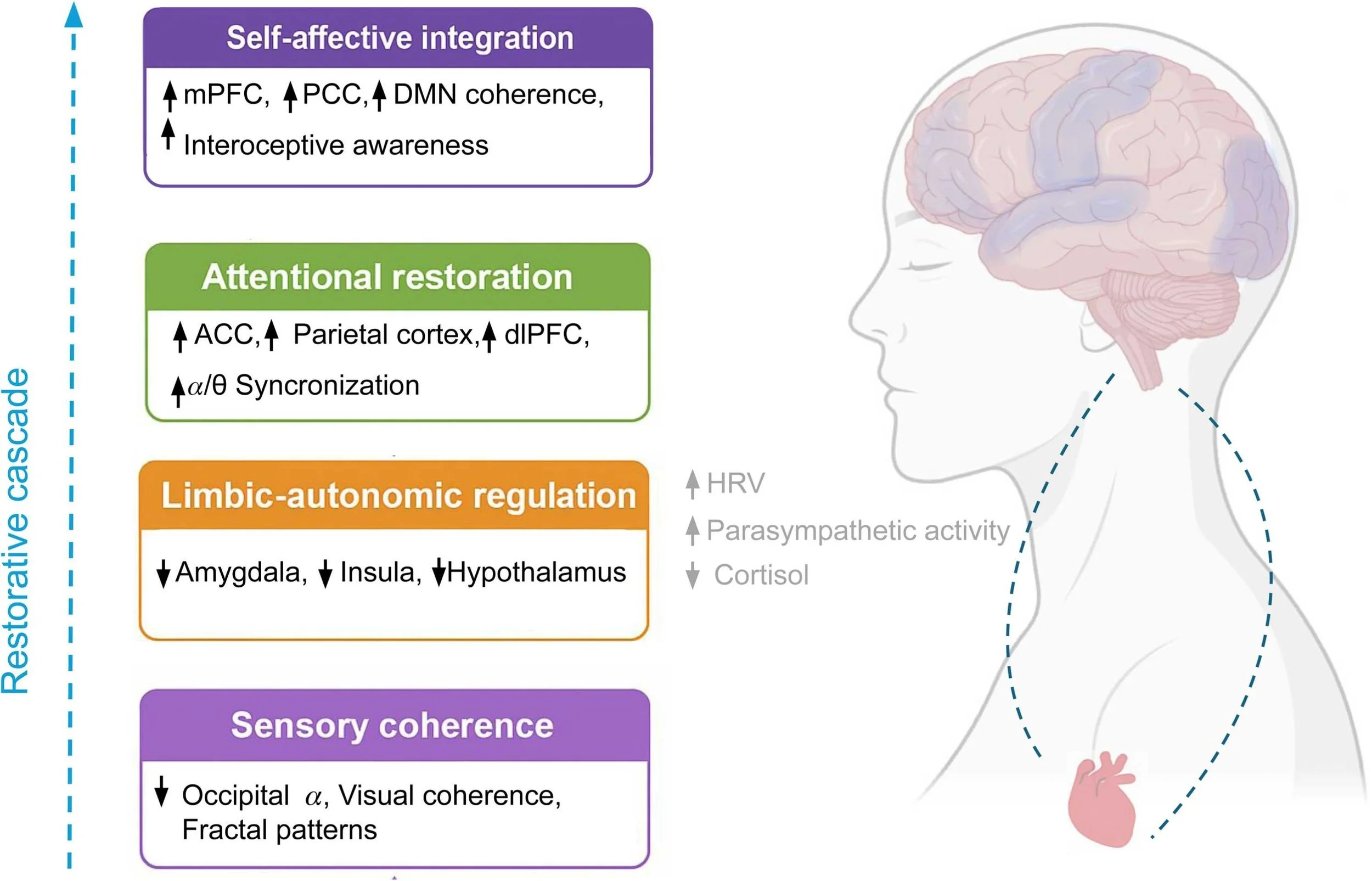
The image below shows how nature helps the brain move from overload towards balance. First, it reduces sensory load. Then it supports stress regulation. After that, it helps restore attention. Finally, it seems to favour a calmer, more integrated sense of self. That’s neuroscience putting into language what our bodies have always felt.
Figure adapted and reproduced from Baquedano et al. Neurosci Biobehav Rev. 2026 Apr;183, under Creative Commons CC BY 4.0 licence.

Science, story and nourishment for neurodivergent life, straight to your inbox.
The restorative cascade
The authors describe a four-level restorative cascade.
1. Sensory coherence
Natural environments contain fractal patterns and visual structures that the brain can process with less effort than the dense, fast-moving stimuli of urban or digital environments. Sensory load decreases, and the visual system works more efficiently.
2. Limbic-autonomic regulation
When sensory load decreases, stress systems begin to settle. Amygdala activity reduces. Parasympathetic activity increases. Heart rate slows down, and the body starts to move out of threat mode.
3. Attentional restoration
With lower stress activation, directed and effortful attention can rest. EEG studies show a greater predominance of alpha and theta rhythms, which are associated with more restorative attentional states.
4. Self-affective integration
Brain networks involved in self-referential processing, including regions of the medial prefrontal cortex and posterior cingulate cortex, show greater functional integration. Rumination decreases and mental noise quietens.
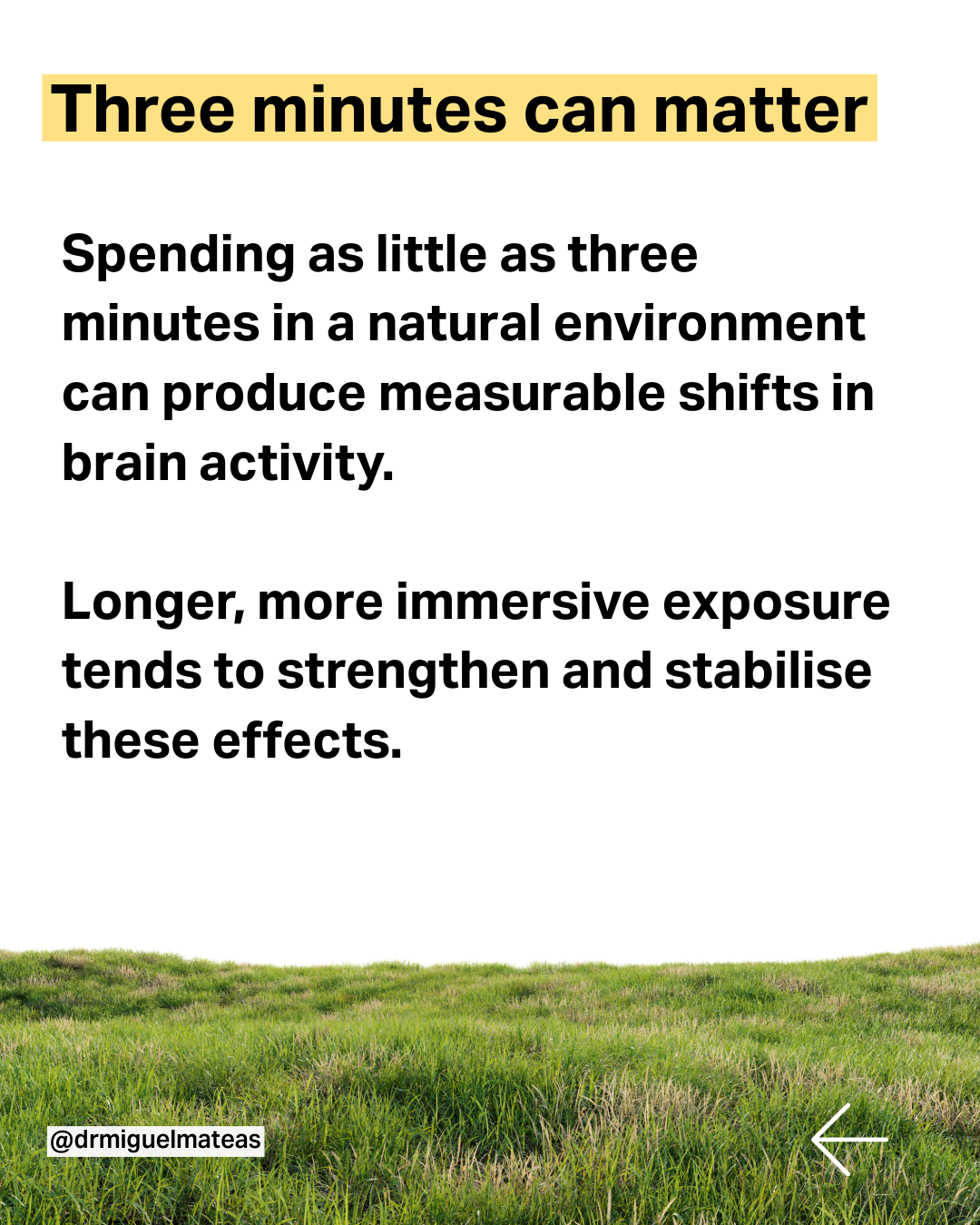
The most important part is that this is not an abstract theory. The analysis of these 100 studies confirms that even brief exposures can produce measurable changes. In some studies, as little as three minutes in a natural environment was associated with changes in brain activity. Longer and more immersive exposures produced stronger and more lasting effects.
Three minutes immersed in nature can produce measurable changes
In some studies, as little as three minutes in a natural environment has been associated with changes in brain activity. Longer and more immersive exposure produces stronger and more lasting effects, but it is reassuring to know that, even on days when you do not have much time, a mini-immersion can still be beneficial.
One question I am asked again and again is: what actually counts as “nature”? And this matters, because the kind of exposure described in the research exists on a spectrum.
Real immersion in parks, forests, or near water tends to produce the most robust effects. But more modest changes are also seen when people view natural scenes on a screen or bring natural elements into indoor spaces. This may help explain why having plants at home can feel so therapeutic, especially in urban environments.
And for neurodivergent people? Isn’t this even more important?
Absolutely. Two thousand per cent.
If your nervous system already works harder to process stimuli, regulate stress and sustain attention, reducing sensory load and supporting autonomic regulation is not a luxury. It is a basic physiological need. And this is not about idealising nature (although it’s not a bad thing to idealise, as it goes…). It is about understanding that the human brain evolved over millions of years while processing coherent biological patterns and that nature is not an escape from real life but an essential part of the nervous system’s regulatory architecture.
I hope this helps you understand yourself more deeply and relate more gently to whatever nature you have around you, whether it’s a river, a park, or a windowsill with some potted plants. It all counts.
With love,