What science is beginning to understand about adult ADHD
For many years, ADHD was understood almost entirely as a childhood disorder. The dominant idea was simple: some children, usually boys, struggled to concentrate, moved around a lot, or acted impulsively. With time, those symptoms were expected to fade. We now know the story is far more complex.
A recent major review published in the journal World Psychiatry brings together what science currently knows about ADHD in adults. It also makes one important point very clear: we are still a long way from fully understanding how this form of neurodivergence lives, breathes and unfolds in adulthood.
As a researcher in this field, what I find particularly interesting is that the paper also offers something very valuable: a map of where the science is heading next. And that map points in three clear directions. First, ADHD is not simply a list of symptoms. Second, ADHD rarely travels alone. And third, context matters more than we used to think. As I read the paper, I could not help smiling. Because this is precisely the broader conversation I explore in ADHD Body & Mind: the need to widen the lens and understand ADHD as something much richer, more embodied and more complex than a checklist of behaviours.
ADHD rarely travels alone
One of the most striking findings in the review is that up to 80 per cent of adults with ADHD have at least one other associated psychiatric condition. This may include anxiety, depression, sleep difficulties or problems linked to substance use.
My own story reflects this quite closely. When I received my ADHD diagnosis in adulthood, other names also appeared in the clinical report: generalised anxiety disorder, social anxiety and a mild depression that never quite seemed to fit the classic picture of depression. Over time, what became clear was that many of those emotional experiences were deeply interwoven with the way I had been living my ADHD for decades. And that is very common. It also tends to go unnoticed for years.
From a clinical point of view, this changes how we understand ADHD. We are not looking at an isolated problem with attention. We are looking at a constellation of biological, psychological and social processes that interact with each other in very real ways.

Science, story and nourishment for neurodivergent life, straight to your inbox.
The environment is part of the story too
Another key idea emerging from this work is the role of social context. The neurodiversity movement has helped reshape the way we interpret conditions such as ADHD. Instead of seeing them only as individual deficits, more attention is now being given to the mismatch between neurodivergent minds and environments designed around neurotypical expectations.
That shift in perspective matters. It invites us to ask better questions. What are our schools really designed for? What kind of attention do our workplaces reward? What happens to a nervous system when the world is full of constant demands, noise, screens, deadlines and social expectations? These questions do not erase the difficulties of ADHD, but they help us understand where some of those difficulties come from.
Inequality also shapes the ADHD experience
Something I spoke about in ADHD Body & Mind, and that rarely receives enough attention in everyday conversations about ADHD, is that access to diagnosis and treatment is not equal for everyone. Women continue to be underdiagnosed compared with men. People from marginalised communities, or those with fewer financial resources, face more barriers when trying to access assessment, diagnosis and appropriate support. The World Psychiatry review also highlights this.
The result is that many people spend decades not understanding why their mind works the way it does. And that lack of understanding tends to come with something very heavy to carry: guilt and shame.
Perhaps one of the most revealing points in the paper is that, for many years, most ADHD research focused on children. Funding for research into adult ADHD remains relatively small compared with other mental health conditions. That is surprising when we consider that adult ADHD is similarly prevalent to other conditions that have received far more scientific attention. In other words, we are still in the early stages of fully understanding how an ADHD mind lives, works, relates, rests, eats, struggles and cares for itself in adulthood.
The conversation is changing
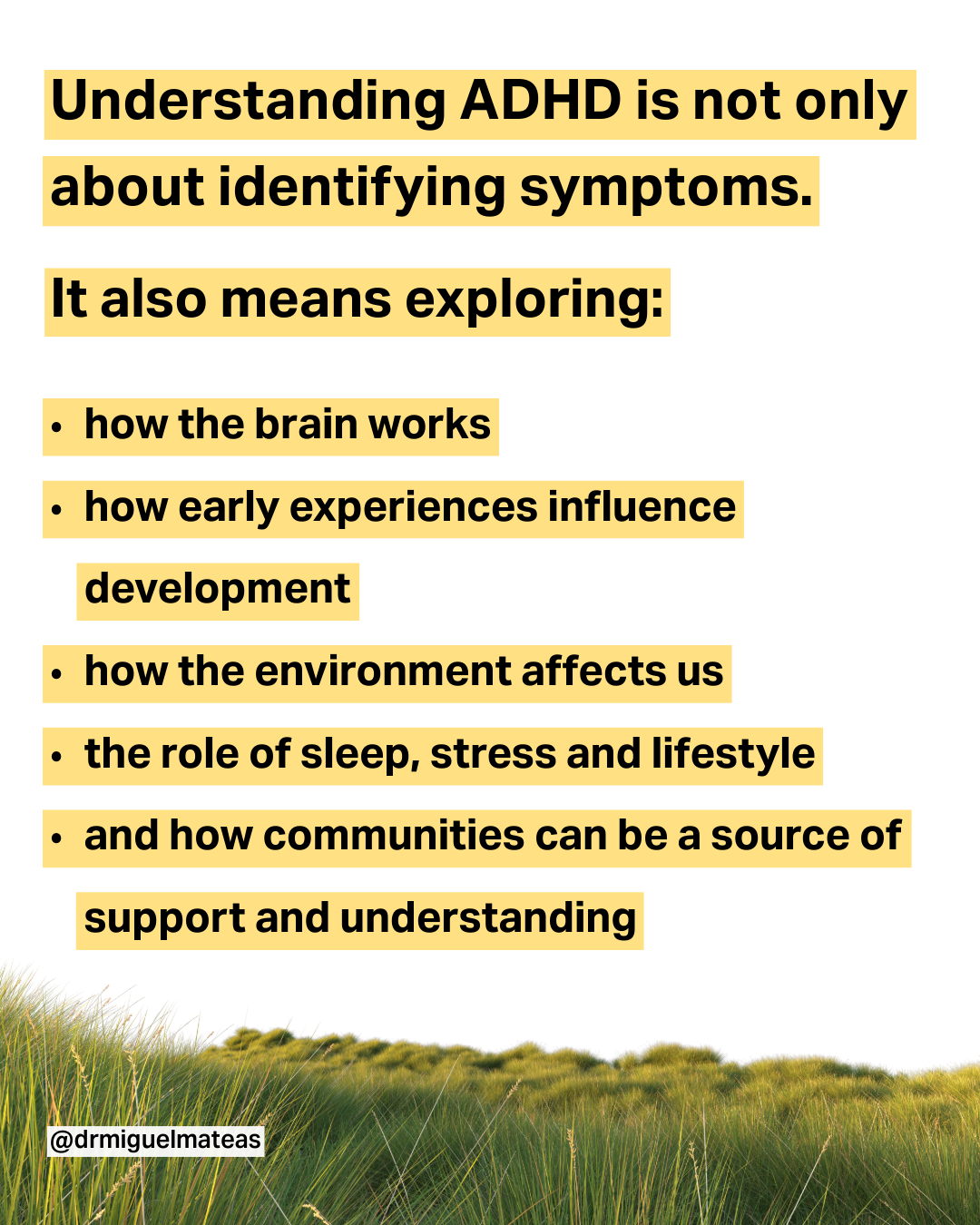
Perhaps the most important message from this scientific review, and the reason I found it so interesting, is that we need to widen our perspective. Understanding ADHD is not only about identifying symptoms. It also means asking how the brain works, how early experiences and social environments shape development, how sleep, stress and everyday habits influence self-regulation, and how support, understanding and belonging can make a meaningful difference to how we live with this form of neurodivergence.
When we bring all these pieces together, a much richer picture begins to appear. A picture that recognises the very real difficulties many people experience, while also acknowledging something equally important: the diversity of human minds. That is why I believe we need to keep broadening the conversation. More researchers, clinicians and people with lived experience are pointing in the same direction.
Call me optimistic, but I think the ADHD conversation is changing. We are no longer talking only about reducing symptoms. We are beginning to talk about creating environments where different kinds of minds can function better. Environments with more understanding, more flexibility and less stigma. Because when our minds feel understood, something shifts. The energy we once spent trying to survive can begin to move towards something much more interesting. Living.
I hope you find the article as interesting as I did. You can read the full text in World Psychiatry here.
With love,