ADHD, stress and eating: When your nervous system is in charge
For many years, many of us with ADHD have received the same message about our relationship with food: that it is about a lack of discipline, poor organisation, or not enough willpower. But when we look at what is happening through the lens of neuroscience, a very different picture begins to appear.
Many of these behaviours are not simply behaviours; they’re in fact nervous system states. When the brain perceives pressure, demand, or threat, the nervous system shifts mode. This happens in everyone, but for us ADHDers it can feel more intense because the circuits involved in attention, reward, and emotional regulation are especially sensitive to stress. They are also the same circuits that shape how we seek relief, stimulation, and reward when our nervous system feels under strain.
In those moments, the prefrontal cortex, the part of the brain that helps us plan, make decisions, and regulate impulses, loses some of its efficiency. Your body then turns to faster strategies to recover a sense of safety, relief, stimulation, or reward. Food can become one of the most direct routes into that state change, not because you’re weak, but because your nervous system is trying to shift how you feel as quickly as possible.
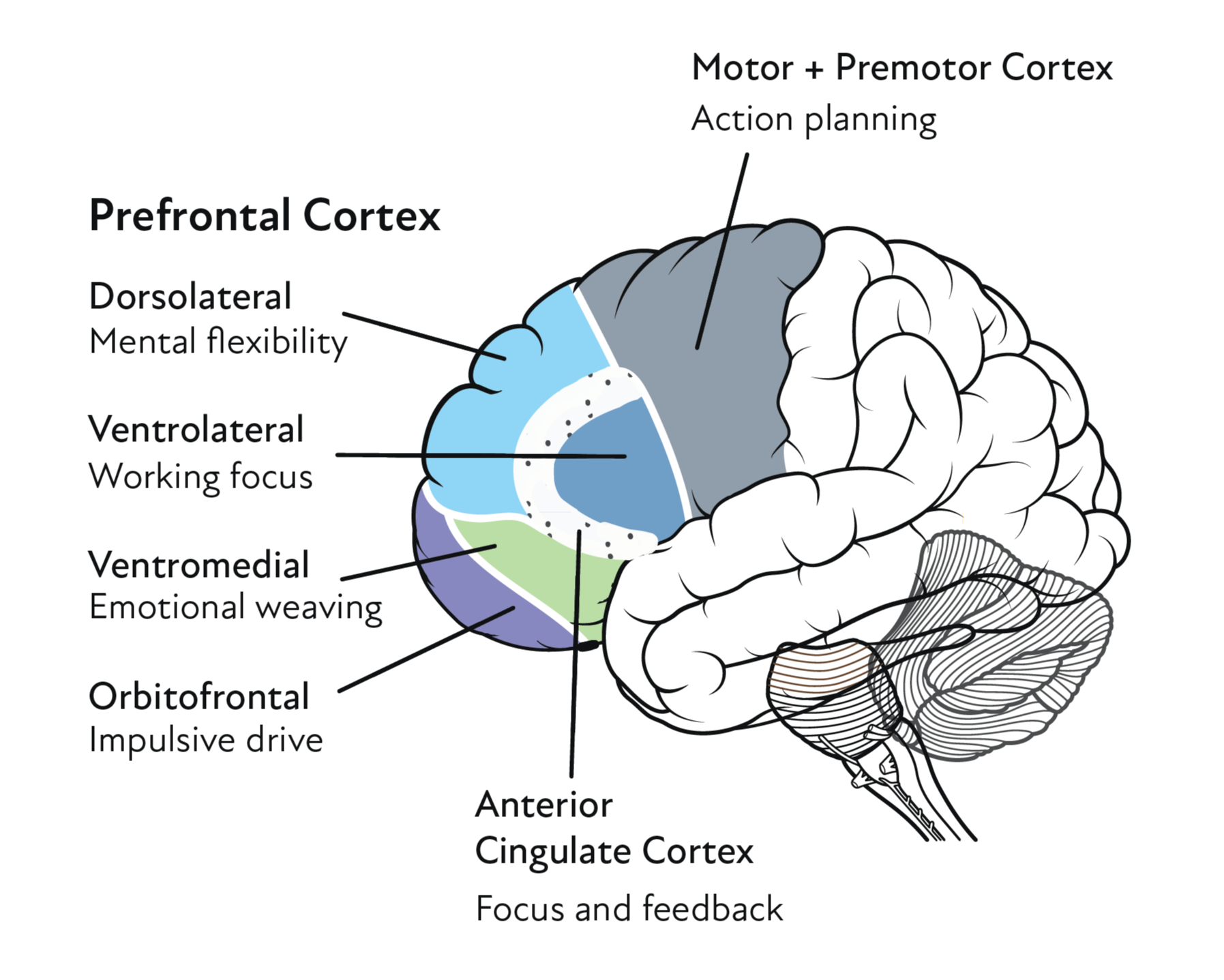
In this image, which I created for my book ADHD Body & Mind, you can see the main areas of the frontal lobe and prefrontal cortex involved in executive function, emotional regulation, and impulse control in ADHD.
Four nervous system responses that also show up in eating
Because of the toxic diet culture that we live in, it is only too easy to interpret natural attempts by our nervous system to regulate itself as “bad eating habits”.
Sometimes the fight response appears.
Tension rises, irritability increases, and your body looks for quick relief. This may show up as eating with urgency, impulsive bingeing, or intense cravings for highly palatable foods.
At other times, the flight response appears.
Your mind tries to escape discomfort. Eating can become a constant distraction: grazing, eating without noticing while doing something else, or moving through cycles of restriction and loss of control.
Freeze can also appear.
Pressure paralyses you. Suddenly, deciding what to cook feels overwhelming, meals slip your mind, or you find yourself staring into the fridge without knowing where to begin.
And there is another response that many people recognise once we name it: fawning. Eating to fit in, to please, to avoid conflict, or to feel a sense of belonging.
When you look at it this way, your relationship with food stops being a moral problem and begins to look more like a conversation between your brain, your body, and your nervous system. The messages may be clear, but they get lost in translation…
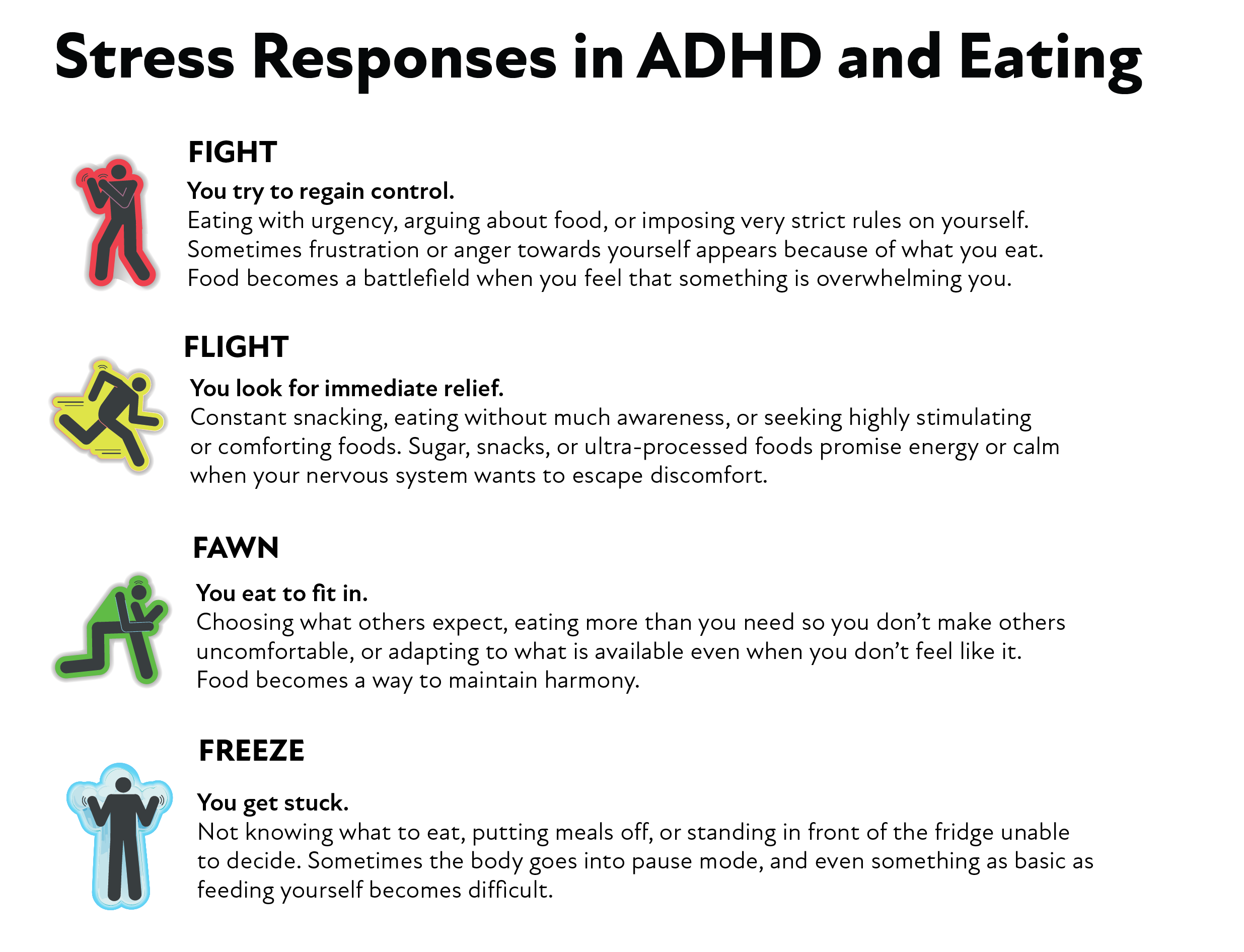
Four nervous system responses to stress that can influence our relationship with food in ADHD.
Transforming guilt into understanding
When we begin to look at our relationship with food through the nervous system, something changes. Guilt starts to loosen, and curiosity takes its place. Curiosity about what your body is trying to regulate when you eat in a particular way. Curiosity about what is happening in your nervous system in that moment, and what forms of support we might be able to offer it.
In my own life, understanding this was a turning point. For years, I thought many of my behaviours around food were about a lack of discipline or not having found “the right strategy”. But the deeper I went into the neuroscience of ADHD, the gut-brain axis, and nervous system regulation, the clearer it became that most of these behaviours are not character flaws, but attempts at regulation.
I have also seen this again and again in my research and in my work with people with ADHD: when we stop fighting against the behaviours and begin to understand what the nervous system is trying to do, something much more useful than guilt becomes available: understanding. And from there, change becomes much easier to begin.

Science, story and nourishment for neurodivergent life, straight to your inbox.
Eating with purpose
Many of us eat for reasons that have very little to do with physical hunger. This can be especially true for ADHDers, and also for those of us who have lived with body dysmorphia, shame, anxiety, or a difficult relationship with our bodies. Sometimes the nervous system moves into survival mode. Sometimes thoughts and emotions become too loud to hold alone. In those moments, food can become comfort, grounding, distraction, stimulation, reward, or a way to soften the noise for a while.
That does not make you weak or undisciplined. It makes you human. It means your brain and body are trying to find a route back to safety with the tools that have been available to you until now.
If you recognise yourself in any of this, I hope you can pause for a moment and hear this clearly: there’s nothing wrong with you. You are responding to overwhelm in ways that make sense when we look at them through the nervous system. And that is a very different starting point…
Perhaps the first step is not to change what you eat, but to begin listening more closely to what your body is trying to tell you.
In my own experience, and in the experiences shared with me by many ADHDers over the years, our relationship with food begins to shift when we stop approaching it through control and start understanding it through regulation. Not through punishment, but through curiosity. Not from the idea that we need to “behave better”, but from the more honest question of what our nervous system is trying to hold in that moment.
Our body has an innate wisdom that many of us have learned to ignore, especially after years of feeling that something in us “wasn’t working as it should”. But when we begin to meet our internal signals with curiosity instead of judgement, something gradually begins to repair. We learn to recognise hunger, tiredness, overload, the search for stimulation, or the need for calm. I talk about this in detail in my book “ADHD Body and Mind”.
This does not mean excusing every behaviour or pretending that change is easy. It means understanding the physiology underneath the behaviour, because shame rarely helps us regulate. Safety, awareness, and support can give the nervous system something different to practise. And the science supports this view. Stress, reward, executive function, emotional regulation, interoception, and the gut-brain axis are all part of this story. When we understand those connections, food stops being framed as a test of willpower and becomes part of a wider conversation about regulation, capacity, and care.
In that process of listening, the body stops feeling like an enemy to control and becomes, once again, an ally we can learn to be in dialogue with, rebuilding trust at our own pace. I hope this article helps you understand yourself a little more deeply, and helps you loosen a layer of guilt that may never have belonged to you in the first place.
With love,