Awe, ADHD and the doorway to the sacred
We tend to think of spirituality as something that happens in temples or within religious traditions, but neuroscience points towards the possibility that, perhaps, spirituality begins with something as simple as a moment of awe. That instant when something stops you inside. A song that reaches the deepest part of you, the silence of a forest, the evening light falling across a building, or an idea that appears suddenly and literally leaves you speechless. In that precise moment, your mind becomes still. And your body knows that something important is happening.
Neuroscience has a word for this state. It is called awe, a deep emotion that arises when we encounter something so vast, beautiful or unexpected that our brain has to reorganise what it knows about the world.
Psychologist Dacher Keltner describes awe as an experience that combines the perception of vastness with the need to adjust our mental models in order to understand what we are encountering. In other words, awe happens when the world becomes a little larger than we thought, and, for a few seconds, the mind opens.

Yesterday, during an early morning walk, the light moved through the trees and reflected quietly on the water. Moments like this awaken something simple and profound in the brain: awe. That instant when the mind softens and attention opens fully to what is in front of you, with the beauty of the moment exceeding your ability to explain or define what is happening. I love bathing in that feeling. I find it incredibly healing…
What happens in the brain when we feel awe
When we experience awe, several things shift in the brain. Studies show reduced activity in networks linked with self-referential thought, known in neuroscience as the default mode network. This is the network that keeps the inner dialogue running, revisiting the past, anticipating the future and wondering what other people might think. When awe appears, that dialogue becomes quieter and something else comes forward: presence.
At the same time, circuits linked with attention and sensory perception become more active. The experience becomes more intense, more vivid. It is as though your brain is saying, “This matters. Pay attention.” Some studies also suggest that awe can alter our perception of time, making us feel as if time has expanded and we have more mental space available. If you have ever felt that a moment seemed to last longer than usual, you may have been experiencing something very close to this. It’s almost as if awe put you in a natural (and legal!) psychedelic trance.

Science, story and nourishment for neurodivergent life, straight to your inbox.
The ADHD mind and the capacity for awe
Many of the ADHDers I speak to every day, myself included, describe a very intense relationship with these kinds of experiences. We may not always identify with traditional forms of spirituality, but we do talk about moments of deep connection when we listen to music, walk in nature, immerse ourselves in a creative project or enter a state of hyperfocus.
In fact, during hyperfocus, the ADHD mind can concentrate in an extraordinary way on something that awakens curiosity or passion. Time changes, attention sharpens and the experience becomes absorbing.
From the outside, this may look like concentration. But, from the inside, those of us with an ADHD nervous system may experience it as a state of deep presence, almost contemplative in quality. In some ways, it is not so different from what happens in certain meditative practices.
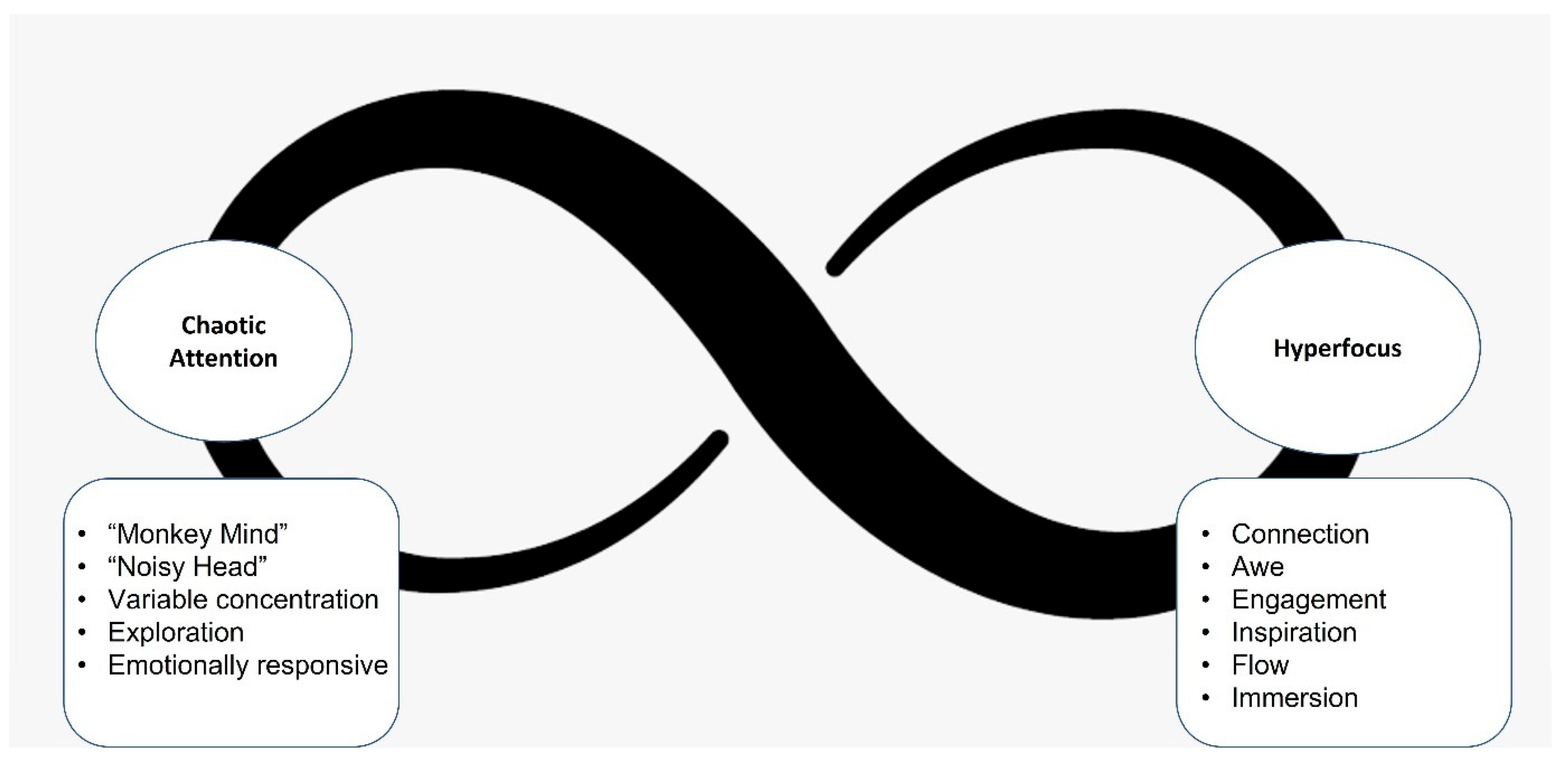
Attention in ADHD is not simply a problem with concentration. It tends to move between two states. On one side, there may be a very active mind, with thoughts moving quickly and attention shifting easily. On the other, there are moments of hyperfocus, when something awakens curiosity or deep interest and the mind becomes fully immersed. In those moments, experiences of connection, inspiration or awe can appear, states very close to what psychology describes as flow.
Figure reproduced from: Champ et al, J Clin Med. 2024 Oct 7;13(19):5963, under Creative Commons CC BY 4.0 licence.
Spirituality outside temples
Spirituality has long been associated with religious institutions, rituals or specific beliefs. Yet, a growing body of research suggests that spiritual experiences can also arise in much more ordinary contexts. Music, art, nature, creativity. Awe. In all of these contexts, the brain enters states that reduce mental noise and amplify perception of the present moment. When that happens, many of us feel something that is difficult to explain with words. A sense of connection with something larger than ourselves.
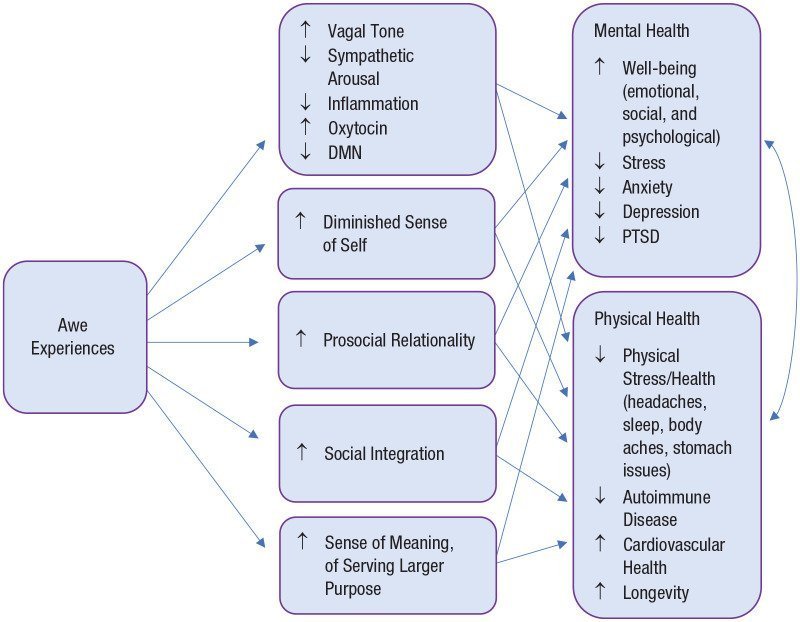
Experiences of awe, such as contemplating nature, listening to music or feeling deeply creatively inspired, produce measurable changes in the brain and body. Research suggests that these moments may increase vagal tone, reduce activation of the stress system and modulate brain networks involved in self-referential thought. They also appear to support social connection, a sense of purpose and integration with others. Taken together, these processes are associated with better psychological wellbeing and physical health benefits, from a lower stress load to improved cardiovascular health.
Figure reproduced from: Monroy et al, Perspect Psychol Sci. 2023 Mar;18(2):309-320, under Creative Commons CC BY 4.0 licence.
Perhaps ADHD spirituality is different
If you live with ADHD, you may have felt at some point that traditional spirituality does not quite fit you. It may come with too many rules, too much stillness or too much structure. But perhaps the spirituality of a neurodivergent mind does not have to look like that.
Perhaps it is found in different places: in a long walk, in a deep conversation or in a song that gives you goosebumps. In a moment of creative hyperfocus when the world disappears for a while. In that instant when your mind, which usually moves so quickly, stops. And then, everything comes together.
So, the next time something fills you with awe, try something very simple. Pause, breathe and let your attention rest on what you are feeling. You do not need to analyse it. You do not even need to understand it. Just stay there for a few seconds. Because sometimes spirituality is not something we have to search for. It appears by itself, in an ineffable moment of awe that your body recognises before your mind does.
Let that sensation move through you. Bathe in it. That vibration is healing. What do you think?
With love,